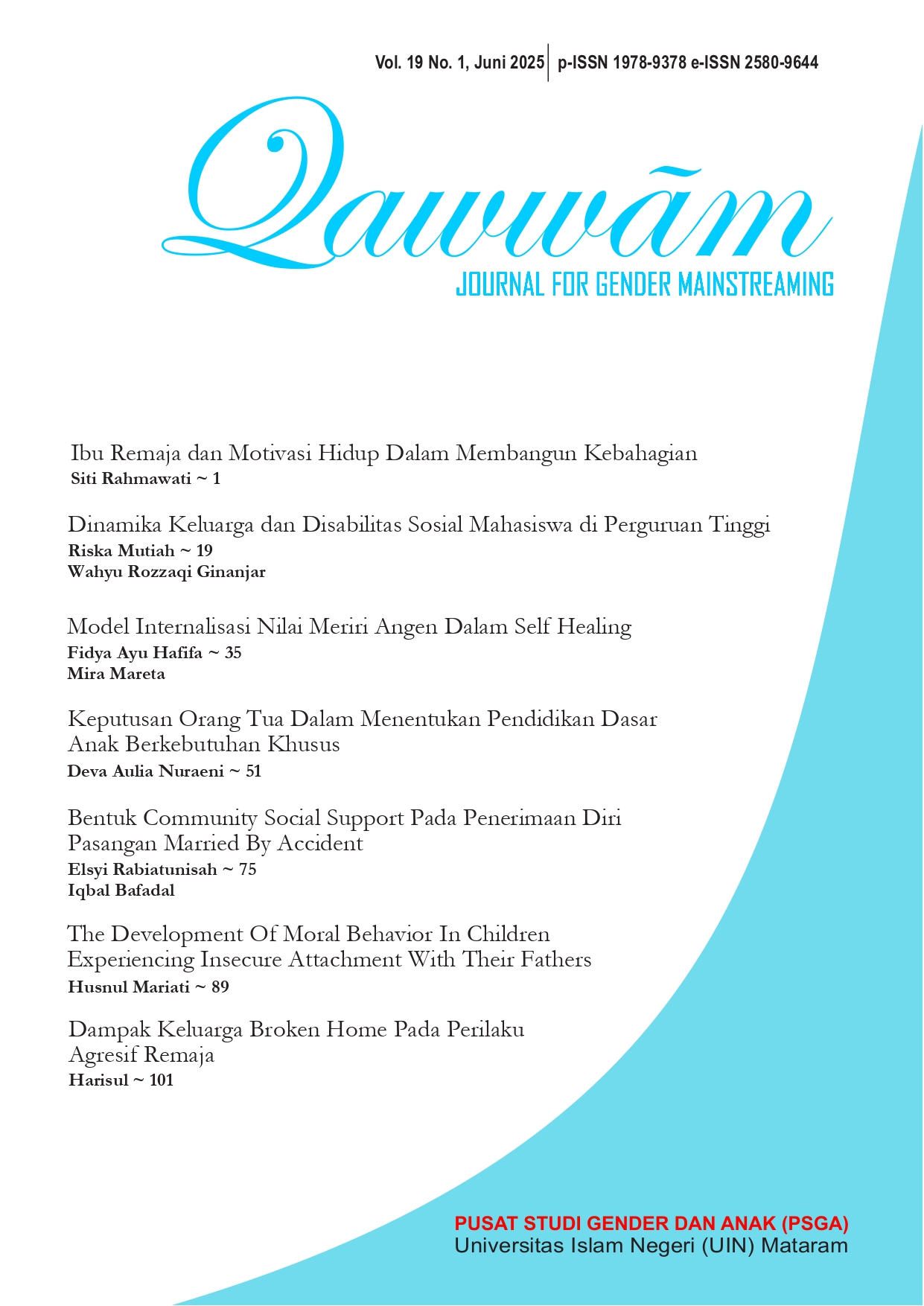
DINAMIKA KELUARGA DAN DISABILITAS SOSIAL MAHASISWA DI PERGURUAN TINGGI
DOI:
https://doi.org/10.20414/qawwam.v19i1.14831Keywords:
Family dynamics, social disabilities, college students, higher education.Abstract
This article analyzes the relationship between family dynamics and social disabilities in college students using a case study method and Bronfenbrenner's Ecological Theory framework. The research focuses on students experiencing functional learning difficulties and mild emotional-behavioral disorders who are being treated through the PUSKA LDS service at UIN Mataram. The findings indicate that the family microsystem plays a significant role in shaping students' psychological and academic well-being. From a chronosystem perspective, these long-term conflict experiences accumulate and influence students' adaptation patterns from adolescence to early adulthood. The mesosystem connecting the family and PUSKA LDS provides a crucial space for intervention through academic and emotional mentoring services that serve as a compensatory mechanism. At the macrosystem level, the existence of inclusive education policies in Indonesia provides a structural basis for universities to provide support for students with disabilities. The results of this analysis confirm that students' social disabilities cannot be understood individually but must be viewed as a product of a complex interaction between family factors, developmental timelines, educational institutions, and national policies. A holistic approach across ecological levels is key to effective prevention and management in higher education.
Downloads
References
Beauchamp-Pryor, Karen. (2011). From Absent to Active Voices: Securing Disability Equality within Higher Education. International Journal of Inclusive Education. http://dx.doi.org/10.1080/13603116.2010.489120
Bronfenbrenner, Urie. (1977). Toward an Experimental Ecology of Human Development. American Psychologist. Cornell University.
Bronfenbrenner, Urie. (1994) Ecological Models of Human Development. International Encyclopedia of Education, Vol. 3, 2nd. Ed. Oxford: Elsevier.
Graham, Linda J. (2024). Inclusive Education for the 21st Century. Routledge.
Grimes, Susan, dkk. (2018). University Student Perspectives on Institutional Non-Disclosure of Disability and Learning Challenges: Reasons for Staying Invisible. International Journal of Inclusive Education. https://doi.org/10.1080/13603116.2018.1442507
Inclusion London. (2015). The Social Model of Disability. http://www.inclusionlondon.org.uk/
Kendall, Lynne. (2016). Higher Education and Disability: Exploring Student Experiences. Cogent Education. https://doi.org/10.1080/2331186X.2016.1256142
Lombok Research Center. (2022). Disabilitas dan Ableisme. https://www.lrcfoundation.com/
Morina, Anabel. (2016). Inclusive Education in Higher Education: Challenges and Opportunities. European Journal of Special Needs Education. https://doi.org/10.1080/08856257.2016.1254964
Permendikbud Nomor 46 Tahun 2014
Radio Republik Indonesia. (2023). Akses Disabilitas di NTB Butuh Peningkatan. https://www.rri.go.id/
Specturum Centre for Independent Living CIC. (2018). Sticks and Stones: The Language of Disability. info@SpectrumCIL.co.uk
United Nations. (2006). Convention on the Rights of Persons with Disabilities.
Undang-undang Nomor 8 Tahun 2016 tentang Disabilitas