
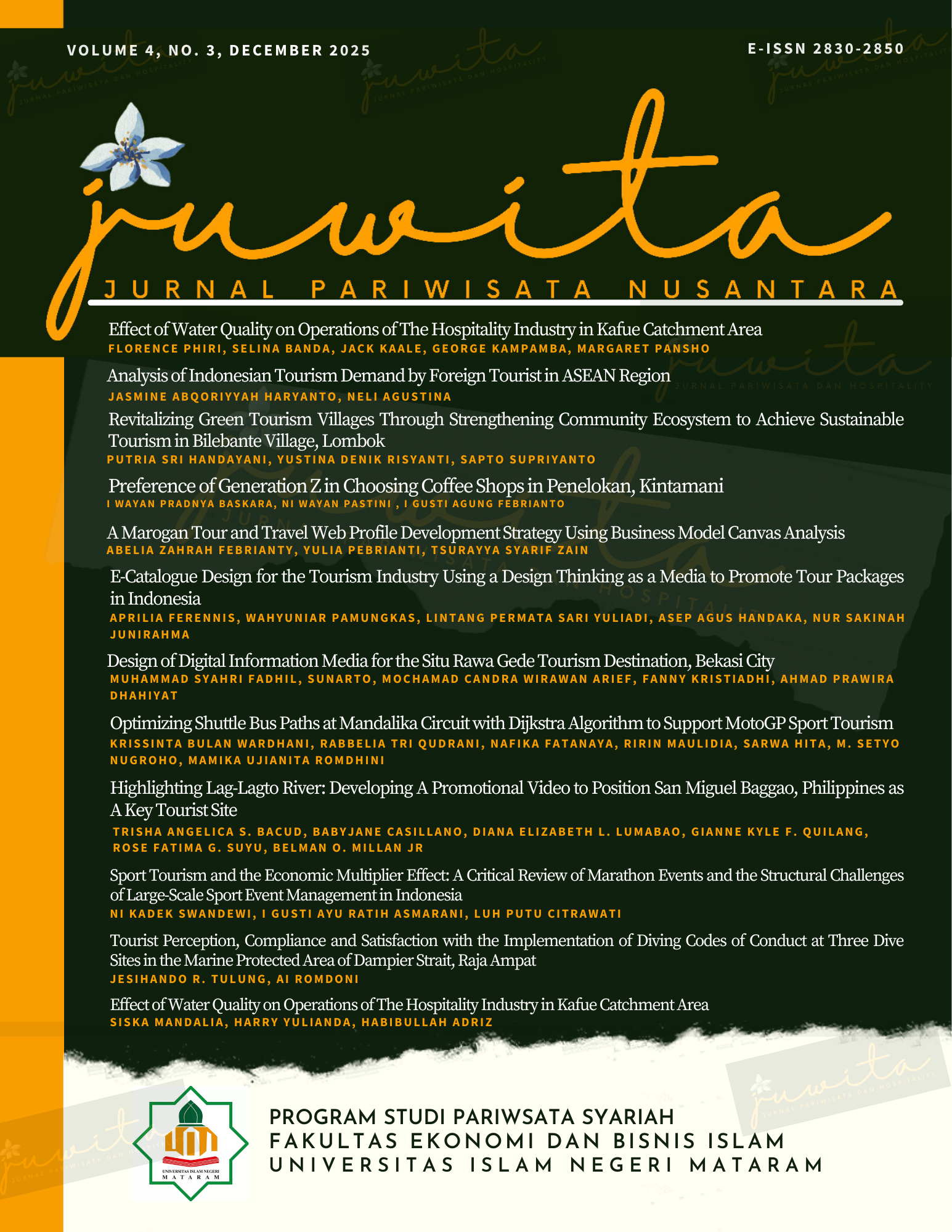
Analysis of Indonesian Tourism Demand by Foreign Tourist in ASEAN Region
Article Sidebar
Main Article Content
Abstract
Purpose: This study aims to assess the overall pattern of ASEAN tourist visits to Indonesia and investigate the potential driving tourism demand between 2017 to 2022. The study focuses on variables believed to influence ASEAN travelers’ interest in Indonesia, such as per capita income, relative pricing, substitution prices, currency exchange rates, and population size.
Method: This study employs panel data covering 9 ASEAN countries—excluding Indonesia and Timor Leste—namely Malaysia, Singapore, Thailand, the Philippines, Laos, Brunei Darussalam, Vietnam, Cambodia, and Myanmar, as the cross-sectional units over the period from 2017 to 2022. The analysis is based on secondary data sourced from BPS, UNCTAD, and the World Bank. The dependent variable is the number of tourists from ASEAN countries. Panel data regression is utilized to identify the factors influencing the demand for tourism in Indonesia by ASEAN visitors during the 2017–2022
Result: The result of the study indicate that the population and per capita income of ASEAN nations have a significant positive impact on ASEAN travelers' demand for travel to Indonesia. In contrast, the fluctuating cost of substituting Indonesian travel with travel to Malaysia, Singapore, and Thailand has a significantly negative impact on the demand for Indonesian tourism. The relative price variable and the Rupiah exchange rate do not significantly impact the demand for Indonesian tourism by ASEAN travelers.
Contribution: The main contribution of this research is a recommended government policy aimed at maintaining price stability in Indonesia to enhance its competitiveness within the ASEAN region. Additionally, efforts should be made to promote domestic tourism through social media campaigns and to enhance the quality and service standards of the tourism sector to boost Indonesia’s appeal. Ensuring currency stability involves implementing a combination of economic and monetary policies, such as balancing currency supply and demand, maintaining macroeconomic stability, managing inflation, and fostering both domestic and foreign investment.
Downloads
Article Details

This work is licensed under a Creative Commons Attribution-ShareAlike 4.0 International License.

This work is licensed under a Creative Commons Attribution-ShareAlike 4.0 International License.
Authors who publish with this journal agree to the following terms:
1. Authors retain copyright and grant the journal right of first publication with the work simultaneously licensed under a Creative Commons Attribution License that allows others to share the work with an acknowledgement of the work's authorship and initial publication in this journal.
2. Authors are able to enter into separate, additional contractual arrangements for the non-exclusive distribution of the journal's published version of the work (e.g., post it to an institutional repository or publish it in a book), with an acknowledgement of its initial publication in this journal.
3. Authors are permitted and encouraged to post their work online (e.g., in institutional repositories or on their website) prior to and during the submission process, as it can lead to productive exchanges, as well as earlier and greater citation of published work (See The Effect of Open Access).
References
Adeola, O., & Evans, O. (2020). ICT, Infrastructure, and Tourism Development in Africa. Tourism Economics, 26(1), 97–114. https://doi.org/10.1177/1354816619827712
Agesti, F. A. (2017). Analisis Permintaan Pariwisata Indonesia: Studi Kasus 6 Negara di Kawasan Asia-Pasifik Tahun 2009-2015. Jurnal Ilmiah Mahasiswa FEB, 5(2).
Agustina, N., Puspita, C. D., Arifatin, D., & Yordani, R. (2021). Application of Logistic Regression to Determine The Quality of Foreign Tourists to Indonesia. Journal of Physics: Conference Series, 1863(1), 012029. https://doi.org/10.1088/1742-6596/1863/1/012029
Al Qudusi, Z. A., & Gunanto, E. Y. A. (2022). Determinan Kunjungan Pariwisata ASEAN (Indonesia, Thailand, Malaysia, Singapura, Vietnam, Filipina, Kamboja, Laos, Myanmar, Brunei Darussalam). E-Jurnal Ekonomi Dan Bisnis Universitas Udayana, 11(11), 1360. https://doi.org/10.24843/EEB.2022.v11.i11.p08
Ali soofi, A., Rafsanjani, S., & Zamanian, G. (2018). Factors Affecting Tourism Demands in Selected OIC Countries. Environmental Energy and Economic Research, 2(4), 229–236. https://doi.org/10.22097/eeer.2019.152925.1047
Baltagi, B. H. (2005). Econometric analysis of panel data (3rd ed.). John Wiley dan Sons.
Gujarati, D. N., & Porter, D. C. (2008). Basic Econometrics 5th Edition. McGraw-Hill.
Hermawan, W. (2020). Analisis Faktor yang Mempengaruhi Kunjungan Wisatawan Manca Negara ke Indonesia. Quantitative Economics Journal, 5(1), 16–27. https://doi.org/10.24114/qej.v5i1.17479
Medyawati, H., & Yunanto, M. (2022). Factors Influencing the Demand for Indonesian Tourism. Journal of Economics and Business, 5(4). https://doi.org/10.31014/aior.1992.05.04.467
Muryani, Permatasari, M. F., & Esquivias, M. A. (2020). Determinants of Tourism Demand in Indonesia: A Panel Data Analysis. Tourism Analysis, 25(1), 77–89. https://doi.org/10.3727/108354220X15758301241666
Nahar, F. H., Adha, M. A., Azizurrohman, M., Ulfi, I., & Karimah, H. (2019). International Tourism Demand in Indonesia: Gravity Model Approach. JEJAK, 12(2), 298–317. https://doi.org/10.15294/jejak.v12i2.19440
Nugraha, Y. R. P., & Naylah, M. (2023). Indonesian Tourism Demand by ASEAN Tourist: A Panel Data Analysis. Signifikan: Jurnal Ilmu Ekonomi, 12(1), 45–56. https://doi.org/10.15408/sjie.v12i1.29894
Pasaribu, M. E., & Suhartini, A. M. (2021). Permintaan Pariwisata Indonesia dari Tujuh Negara ASEAN Tahun 2005-2019?: Analisis Regresi Data Panel. Seminar Nasional Official Statistics, 838–846. https://www.unwto.org/,
Pratomo, S. D. (2009). Permintaan Pariwisata Indonesia: Studi Kasus Wisatawan Malaysia. In Journal of Indonesian Applied Economics (Vol. 3, Issue Oktober).
Pyndick, R., & Rubinfeld, Daniel. L. (2013). Microeconomics Eight Edition. Pearson Education. www.myeconlab.com
Sugianto, S., Ramadhani, S., & Jumain, A. H. (2022). Faktor-Faktor Yang Mempengaruhi Jumlah Kunjungan Wisatawan Mancanegara (Wisman) Di Provinsi Nusa Tenggara Barat. Jurnal Locus Penelitian Dan Pengabdian, 1(2), 48–59. https://doi.org/10.58344/locus.v1i2.14
Tan, C.-Y., & Soon, S.-V. (2023). Tourism Demand for Malaysia: Further Evidence from Panel Approaches. Asia Pacific Management Review, 28(4), 459–469. https://doi.org/10.1016/j.apmrv.2022.12.006
Taupikurrahman. (2022). Determinan Permintaan Pariwisata Internasional di Indonesia: Panel FMOLS Determinants International Tourism Demand in Indonesia. Forum Ekonomi, 24(2), 299–306. https://doi.org/10.29264/jfor.v24i2.10915
Tucker, Irvin. B. (2017). Macroeconomics For Today Ninth Edition. Cengage Learning.
Ulucak, R., Yücel, A. G., & ?lkay, S. Ç. (2020). Dynamics of Tourism Demand in Turkey: Panel Data Analysis Using Gravity Model. Tourism Economics, 26(8), 1394–1414. https://doi.org/10.1177/1354816620901956
United Nations World Tourism Organization. (2010). International Recommendations for Tourism Statistics 2008.