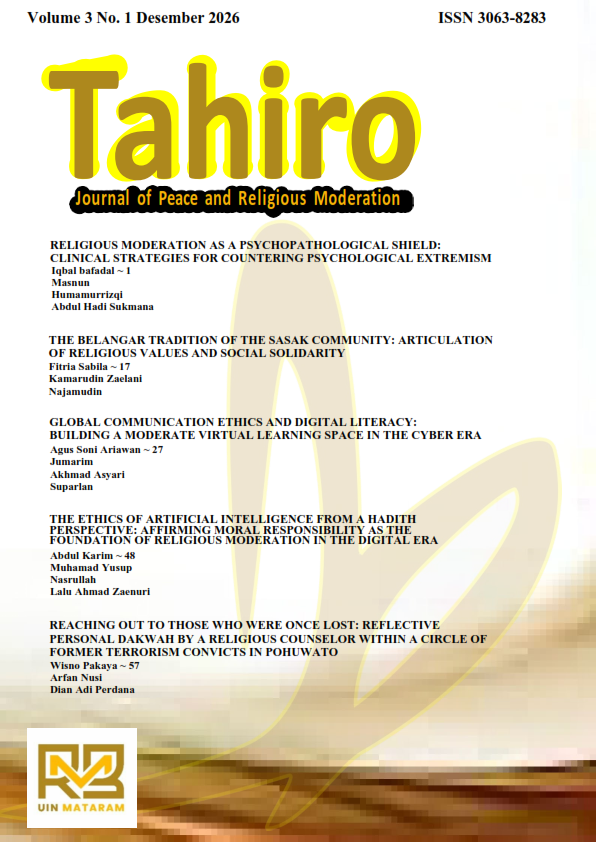
THE ETHICS OF ARTIFICIAL INTELLIGENCE FROM A HADITH PERSPECTIVE: AFFIRMING MORAL RESPONSIBILITY AS THE FOUNDATION OF RELIGIOUS MODERATION IN THE DIGITAL ERA
DOI:
https://doi.org/10.20414/tahiro.v3i1.14776Keywords:
Artificial Intelligence, Hadith, Islamic Ethics, Religious Moderation, Islamic AI EthicsAbstract
The development of artificial intelligence (AI) has brought fundamental change to human life while simultaneously presenting complex ethical challenges: algorithmic bias, dehumanization, data misuse, and a crisis of moral accountability. Within the context of a plural and multicultural society, these challenges are not merely technical in dimension but also touch upon the realm of religious values, moderation, and social harmony as seen in various cases of generative AI-produced content (images, text, and synthetic audio) that have sparked religious controversy in Indonesia's digital space, ranging from representations of religious figures and symbols deemed inappropriate to fake sermons or fatwas generated by AI and circulated on social media. This research aims to analyze AI ethics through the lens of hadith by affirming moral responsibility as the foundation of religious moderation in the digital era. Using a qualitative approach with library research methods and hadith hermeneutic analysis, the study examines primary sources from the Kutub al-Sittah along with their commentaries (syarah), as well as contemporary literature on AI ethics and Islamic moderation. The findings show that the principles of AI ethics justice, transparency, accountability, beneficence, and non-maleficence share strong points of convergence with the values of the Prophet's hadith. The hadith on leadership accountability (HR. Bukhari-Muslim), the principle of lā ḍarar wa lā ḍirār (HR. Ibn Mājah), and the hadith on itqan (HR. al-Baihaqi) not only provide an ethical foundation for AI development, but also affirm the principle of wasaṭiyyah (the middle path) as the basis for moderation in technology governance. The resulting Islamic AI Ethics framework offers moral guidance for developers, users, and regulators so that AI may contribute to universal benefit, avoid digital radicalization, and reinforce the role of Islam as rahmatan lil-'ālamīn.
Downloads
References
Abubakar, A., dan A. Ridha. "Al-Qur'an Dan Kecerdasan Buatan (Suatu Kajian Tematik)." AL-WAJID: Jurnal Ilmu Al-Qur'an dan Tafsir, ejournal.iain-bone.ac.id, 2024.
Akbar, A., dan R. R. Kurniawan. "AI Dan Dampaknya Pada Perekonomian Menurut Fiqih." Media STIE Prabumulih, 2023.
Akbar, T. A. "Etika Islam Dalam Pemanfaatan Kecerdasan Buatan (AI) Untuk Mencapai Studi Islam Yang Modern Dan Berorientasi Pada Kemanusiaan." Prosiding Kajian Islam dan Integrasi Ilmu, jurnal.uindatokarama.ac.id, 2025.
Alhubilah, F., MZAF Al Farisi, et al. "Bridging Artificial Intelligence and Revelation: Semantic Analysis on Chapter Al-'Alaq in the Qur'an through the Artificial Neural Networks Perspective." Journal of Quran and Hadith Studies, ejournal.iainkerinci.ac.id, 2025.
Arif, M., S. Irfan, M. M. R. Shaoan, dan W. Ali. "AI and Machine Learning in Islamic Guidance: Opportunities, Ethical Considerations, and Future Directions." Guidance: Jurnal Bimbingan, jurnal.uia.ac.id, 2024.
Azzahrowaini, L., M. W. Shohib, dan M. N. R. Maksum. "Digitalisasi Pembelajaran Tahfidz Al-Qur'an Berbasis AI Dalam Inovasi Tantangan Dan Implementasi." Educatio, e-journal.hamzanwadi.ac.id, 2025.
Al-Bukhārī, Muhammad ibn Ismail. Ṣaḥīḥ al-Bukhārī. Kairo: Dar al-Tauq al-Najah, 1422 H.
Al-Nawawī, Yahya ibn Sharaf. Al-Minhāj Sharh Ṣaḥīḥ Muslim ibn al-Ḥajjāj. Beirut: Dar Ihya' al-Turath al-'Arabi, 1392 H.
Fauzan, A. N., dan E. Musaddad. "Digitalization of Hadith and Its Challenges in the Current of Globalization." Aslama: Journal of Islamic Studies, aslama.kjii.org, 2025.
Fauzan, M. A., A. Q. A'yun, et al. "Analisis Hadis Keutamaan Ilmu Dalam Konteks Pendidikan Islam." SETYAKI: Jurnal Pendidikan Islam, 2024.
Hakim, F., A. Fadlillah, dan M. N. Rofiq. "Artificial Intelligence (AI) Dan Dampaknya Dalam Distorsi Pendidikan Islam." Urwatul Wutsqo: Jurnal Studi Kependidikan, 2024.
Hamidi, MF Al, A. W. Fitriyah, et al. "Artificial Intelligence Dan Implikasinya Terhadap Pengkajian Studi Islam Pada Generasi Z." Jurnal Tarbiyatuna, ejournal.iaida.ac.id, 2024.
Hastuty, A., M. Maswati, M. Saharuddin, A. M. Sukri, dan A. Halik. "Artificial Intelligence: A Review of the Philosophy of Islamic Educational Science." Journal of Research in Islamic Education, 2025.
Heriansyah, D., dan M. S. Qalby. "Era Industri 4.0: Nilai-Nilai Etika Pada Masyarakat Terhadap Penggunaan Media Sosial Dalam Perspektif Hadis." Jurnal Dakwah dan Ilmu Komunikasi, 2024.
Hernawati, S., M. Hafizh, et al. "Adjusting the Ideal Islamic Religious Education Curriculum to the Development of AI-Based Technology." Progresiva: Jurnal Pemikiran dan Pendidikan Islam, ejournal.umm.ac.id, 2024.
Hosni, A., M. F. M. Ariffin, dan H. Ishak. "Editorial Notes: Isu Dan Cabaran ChatGPT Terhadap Pengajian Islam." Al-Turath Journal of Al-Quran and Al-Sunnah, 2023.
Ibn Ḥajar al-'Asqalānī, Ahmad ibn Ali. Fatḥ al-Bārī bi Sharḥ Ṣaḥīḥ al-Bukhārī. Beirut: Dar al-Ma'rifah, 1379 H.
Ibn Mājah, Muhammad ibn Yazid. Sunan Ibn Mājah. Kairo: Dar Ihya' al-Kutub al-'Arabiyyah, t.t.
Jaiyeoba, H. B., T. Ushama, et al. "Al-Quran Sebagai Sumber Panduan Etika Dan Moral Dalam Masyarakat Kontemporari." Al-Irsyad: Journal of Islamic Studies, 2024.
Mahmudulhassan, M., et al. "Artificial Intelligence in Multicultural Islamic Education: Opportunities, Challenges, and Ethical Considerations." Universal Journal of Islamic Education and Management, 2024.
Majid, A. H. Etika Komunikasi Di Era Digital Perspektif Al-Qur'an: Studi Penafsiran Sufistik Ibnu 'Ajībah Dalam al-Baḥr al-Madīd. Surabaya: Alfithrah Press, 2024.
Malik, R., A. Malik, dan M. Mustika. "Artificial Intelligence and Islamic Law: Ethical Implications and Fiqh Fatwas in the Digital Age." Journal of Family Law and Islamic Court, 2024.
Muslim ibn al-Hajjaj. Ṣaḥīḥ Muslim. Diedit oleh Muhammad Fu'ad 'Abd al-Baqi. Kairo: Dar Ihya' al-Turath al-'Arabi, t.t.
Ni'am, A. M., P. Parhan, I. Basyarahil, dan N. Hidayaturrohmah. "Cultivating Spiritual Intelligence in Education during the Era of Artificial Intelligence Based on the Concept of Educational Psychology in the Al-Qur'an." Jurnal Penelitian Ilmu Pendidikan, 2025.
Rahmi, M., D. Daipon, dan N. Saprina. "AI Simulation of Digital Afterlife: Artificial Intelligence in the Framework of Islamic Law." ICMIL Proceedings, 2024.
Resky, M., dan Y. Suharyat. "Analysis of AI Technology Utilization in Islamic Education: Analisis Pemanfaatan Teknologi AI Dalam Pendidikan Islam." Procedia of Social Sciences and Humanities, 2024.
Rosyad, S., dan M. Alif. "Hadis Di Era Digital: Tantangan Dan Peluang Penggunaan Teknologi Dalam Studi Hadis." Jurnal Ilmu Agama: Mengkaji Doktrin, Pemikiran, dan Fenomena Agama, 2023.
Downloads
Published
Issue
Section
License
Copyright (c) 2026 Abdul Karim, Muhamad Yusup, Nasrullah, Lalu Ahmad Zaenuri

This work is licensed under a Creative Commons Attribution-ShareAlike 4.0 International License.