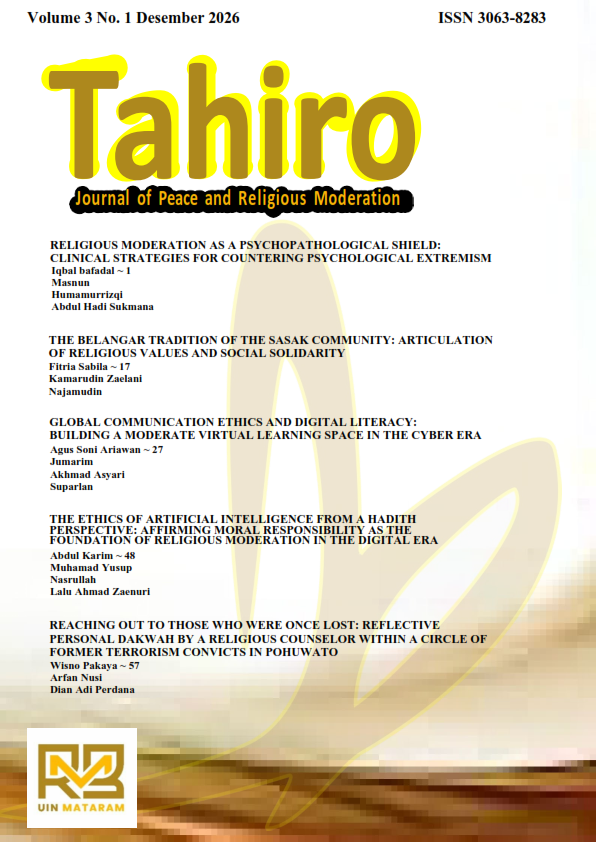
GLOBAL COMMUNICATION ETHICS AND DIGITAL LITERACY: BUILDING A MODERATE VIRTUAL LEARNING SPACE IN THE CYBER ERA
DOI:
https://doi.org/10.20414/tahiro.v3i1.15521Keywords:
Digital Literacy, Communication Ethics, ELT, Islamic Moderation, Virtual Learning Space, Washathiyah, Digital DisinformationAbstract
This research examines the convergence of global communication ethics and digital literacy within the context of English Language Teaching (ELT) in the cyber era, grounded in the values of Islamic moderation (Islam Washathiyah). The study takes the form of an analytical-critical literature review reinforced by global empirical data on the contemporary digital landscape. The main conceptual contribution of this research lies in the repositioning of Washathiyah: not merely as a complementary value or ethical qualifier to existing Western frameworks of digital literacy and intercultural competence, but as an epistemological principle that reshapes how those frameworks are understood and operationalized. By integrating the Spectrum Concept of the Self theory, the framework of intercultural communicative competence, and critical digital literacy models, this research argues that the greatest threats within the digital ecosystem ranging from disinformation and hate speech to online radicalization are manifestations of a systemic ethical crisis. Data show that Indonesia, with 212 million active internet users and a digital literacy ranking of 64th out of 100 countries, stands at a critical crossroads between digital opportunity and threat. The findings identify three Washathiyah-based protective mechanisms that are genuinely novel in their framing: (1) critical digital literacy as an epistemological shield against disinformation, rooted in the principle of tabayyun rather than merely borrowed from it; (2) intercultural communicative competence grounded in the values of ta'aruf and tasamuh, which reconstructs not merely supplements Byram's ICC model; and (3) the design of a moderate virtual learning space (the WASH Framework), which positions teachers as facilitators of digital ethics. The implications of this research extend beyond the ELT context and offer a framework for the entire Muslim educational ecosystem in the cyber era.
Downloads
References
Annamalai, N., Abdullah, M. S., & Alasam, A. (2021). "WhatsApp-Mediated Language Learning: Student and Teacher Perspectives." TESOL Quarterly, 55(4), 1161-1176.
Ariawan, S. Pemanfaatan Aplikasi HelloTalk dalam Peningkatan Kemampuan Speaking Mahasiswa EFL. Laporan internal, Universitas Islam Negeri Mataram (status: belum dipublikasikan secara formal).
Bandura, A. (1977). Social Learning Theory. Englewood Cliffs: Prentice Hall.
BNPT. (2023). Laporan Tahunan Pencegahan Radikalisasi Digital 2023. Jakarta: Badan Nasional Penanggulangan Terorisme.
Boyd, D. (2014). It's Complicated: The Social Lives of Networked Teens. New Haven: Yale University Press.
BPS. (2023). Statistik Telekomunikasi Indonesia 2023. Jakarta: Badan Pusat Statistik.
Byram, M. (1997). Teaching and Assessing Intercultural Communicative Competence. Clevedon: Multilingual Matters.
Cherner, T., & Lee, C. (2016). "Presenting a Framework for Technology-Enhanced Teaching and Learning." Journal of Teaching and Learning with Technology, 5(2), 39-68.
Deardorff, D. K. (2006). "Identification and Assessment of Intercultural Competence as a Student Outcome of Internationalization." Journal of Studies in International Education, 10(3), 241-266.
Dignum, V. (2019). Responsible Artificial Intelligence: How to Develop and Use AI in a Responsible Way. Cham: Springer.
EIU (Economist Intelligence Unit). (2023). Digital Education Report 2023: Readiness Index. London: The Economist Group.
Faruque, M. U. (2020). Sculpting the Self: Islam, Selfhood, and Human Flourishing. Michigan: University of Michigan Press.
Gilster, P. (1997). Digital Literacy. New York: Wiley.
Hobbs, R. (2010). Digital and Media Literacy: A Plan of Action. Washington DC: Aspen Institute.
Human Rights Watch. (2022). "How Dare They Peep Into My Private Life": Children's Rights Violations by Governments that Endorsed Online Learning During the Covid-19 Pandemic. New York: HRW.
Hutchinson, P. (2021). "Uncivil Discourse in Online Learning Environments: A Mixed-Methods Study." Computers & Education, 172, 104270.
Ibn 'Asyur, Muhammad al-Tahir. Maqashid al-Syari'ah al-Islamiyyah. Amman: Dar al-Nafais, 2001.
Institute for Strategic Dialogue (ISD). (2023). The Rabbit Hole: How YouTube Radicalizes Users. London: ISD Global.
Jenkins, H., Purushotma, R., Weigel, M., Clinton, K., & Robison, A. (2009). Confronting the Challenges of Participatory Culture: Media Education for the 21st Century. Cambridge: MIT Press.
Kamali, M. H. (2015). The Middle Path of Moderation in Islam: The Qur'anic Principle of Wasatiyyah. Oxford: Oxford University Press.
Kaspersky Security Network. (2023). IT Threat Evolution Q3 2023: Southeast Asia Statistics. Moscow: Kaspersky Lab.
Katadata Insight Center. (2023). Indeks Literasi Digital Indonesia 2023. Jakarta: Katadata.
Kominfo. (2024). Laporan Penanganan Konten Hoaks 2019-2024. Jakarta: Kementerian Komunikasi dan Informatika.
Manca, S., & Ranieri, M. (2016). "Facebook and the Others: Potentials and Obstacles of Social Media for Teaching in Higher Education." Computers & Education, 95, 216-230.
MIT Media Lab / Vosoughi, S., Roy, D., & Aral, S. (2018). "The Spread of True and False News Online." Science, 359(6380), 1146-1151.
Orben, A., & Przybylski, A. K. (2019). "The Association Between Adolescent Well-Being and Digital Technology Use." Nature Human Behaviour, 3, 173-182.
Pennycook, G., Binnendyk, J., Newton, C., & Rand, D. G. (2021). "A Practical Guide to Doing Behavioral Research on Fake News and Misinformation." Collabra: Psychology, 7(1).
Pennycook, G., & Rand, D. G. (2019). "Lazy, Not Biased: Susceptibility to Partisan Fake News is Better Explained by Lack of Reasoning than Motivated Reasoning." Cognition, 188, 39-50.
Riedl, R. (2022). "On the Biology of Technostress: Literature Review and Research Agenda." Data Base for Advances in Information Systems, 53(1), 61-90.
Shadiev, R., & Yang, M. (2020). "Review of Studies on Technology-Enhanced Language Learning and Teaching." Sustainability, 12(2), 524.
Snyder, H. (2019). "Literature Review as a Research Methodology: An Overview and Guidelines." Journal of Business Research, 104, 333-339.
Speight, S. (2014). "Authentic Learning: Its Role in E-Learning for Language Teaching." IALLT Journal of Language Learning Technologies, 44(2), 60-82.
Suler, J. (2004). "The Online Disinhibition Effect." CyberPsychology & Behavior, 7(3), 321-326.
Twenge, J. M., Haidt, J., Lozano, J., & Cummins, K. M. (2023). "Specification Curve Analysis Shows That Social Media Use Is Linked to Poor Mental Health, Especially Among Girls." Acta Psychologica, 232, 103814.
UIN Mataram. (2021). Pedoman Implementasi Nilai-nilai Moderasi Beragama dalam Pendidikan. Mataram: UIN Mataram Press.
UNESCO. (2022). A Global Framework of Reference on Digital Literacy Skills for Indicator 4.4.2. Montreal: UNESCO Institute for Statistics.
UNESCO Institute for Statistics. (2023). Global Education Monitoring Report 2023: Technology in Education. Paris: UNESCO.
UNICEF Indonesia. (2022). U-Report on Cyberbullying: A Survey of 14-24-Year-Old Indonesians. Jakarta: UNICEF Indonesia.
Vallor, S. (2016). Technology and the Virtues: A Philosophical Guide to a Future Worth Wanting. Oxford: Oxford University Press.
Ware, P., & Kramsch, C. (2005). "Toward an Intercultural Stance: Teaching German and English through Telecollaboration." Modern Language Journal, 89(2), 190-205.
Wardle, C., & Derakhshan, H. (2017). Information Disorder: Toward an Interdisciplinary Framework for Research and Policy Making. Strasbourg: Council of Europe.
Warschauer, M., & Healey, D. (1998). "Computers and Language Learning: An Overview." Language Teaching, 31(2), 57-71.
We Are Social & Meltwater. (2024). Digital 2024 Global Overview Report. New York: We Are Social.
Downloads
Published
Issue
Section
License
Copyright (c) 2026 Soni Ariawan, Jumarim, Akhmad Asyari, Suparlan

This work is licensed under a Creative Commons Attribution-ShareAlike 4.0 International License.