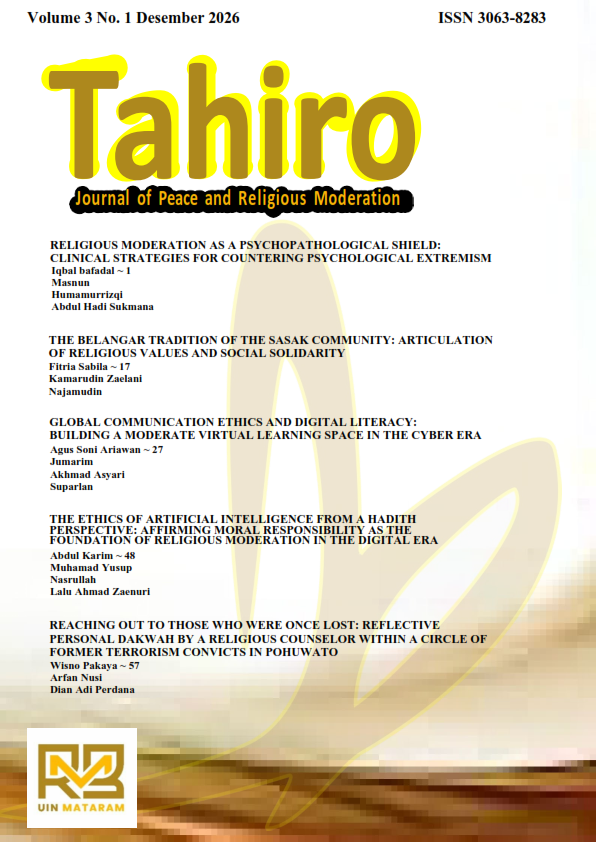
RELIGIOUS MODERATION AS A PSYCHOPATHOLOGICAL SHIELD: CLINICAL STRATEGIES FOR COUNTERING PSYCHOLOGICAL EXTREMISM
DOI:
https://doi.org/10.20414/tahiro.v3i1.15524Keywords:
Islamic Psychology, Religious Moderation, Mental Wellbeing, Wasatiyyah, Qalb SalimAbstract
This research presents an academic synthesis of religious moderation (Wasatiyyah) as a preventive intervention against psychopathology, grounded in Muhammad U. Faruque's multidimensional self model. The normative foundation of Wasatiyyah is rooted in the concept of maqashid al-shariah as formulated by classical scholars, including Ibn 'Asyur in Maqashid al-Syari'ah al-Islamiyyah and Yusuf Al-Qaradawi in Al-Shahwah al-Islamiyyah, both of whom regard balance (wasath) as both the objective of the shariah and a principle for the protection of the soul (hifzh al-nafs). From the perspective of Islamic psychology, moderation is understood not merely as a sociopolitical compromise, but as a clinical necessity that can be operationalized through measurable psychological indicators, such as moderate religiosity scales, dogmatism scales (Rokeach, 1960), and the Religious Moderation Assessment (RMA), in order to maintain balance among the bio-physiological, cognitive, and spiritual dimensions of the human being. This analysis highlights that extremism arises from a “spectrum error,” in which the individual reduces the transcendent subjectivity of the “I” into a rigid and closed ideological object. By integrating Abu Zayd al-Balkhi's classical medical tradition in his work Masalih al-Abdan wa al-Anfus with the practice of Tajarrud (self-detachment) from the Sunni Sufi tradition, this research proposes a new framework for holistic mental health. The method employed is an analytical-critical literature review of primary sources in Islamic psychology and the philosophy of the soul. The findings show that the Wasatiyyah approach is clinically proven to protect human moral agency and to facilitate the attainment of Qalb Salim as the highest condition of mental health in the Islamic tradition. The implications of this research include recommendations for mental health practitioners and educators in Muslim communities to adopt the principle of moderation as a methodology for psychological intervention grounded in Islamic spiritual values.
Downloads
References
Al-Balkhi, Abu Zayd. Masalih al-Abdan wa al-Anfus. Diterjemahkan dan diedit oleh M. Badri. Kairo: IIIT, 2013.
Al-Bukhari, Muhammad ibn Ismail. Shahih al-Bukhari. Kairo: Dar al-Tauq al-Najah, 1422 H.
Al-Ghazali, Abu Hamid. Ihya' Ulum al-Din. 4 jilid. Kairo: Dar al-Hadith, 2004.
Al-Krenawi, A., & Graham, J. R. "Culturally Sensitive Social Work Practice with Arab Clients in Mental Health Settings." Health & Social Work 25, no. 1 (2000): 9–22.
Al-Maraghi, Ahmad Mustafa. Tafsir al-Maraghi. 30 jilid. Kairo: Matba'ah Mustafa al-Babi al-Halabi, 1946.
Al-Qaradawi, Yusuf. Al-Shahwah al-Islamiyyah: Bayna al-Juhud wa al-Tatharruf. Kairo: Dar al-Shahwah, 1996.
Al-Thabari, Muhammad ibn Jarir. Jami' al-Bayan fi Ta'wil al-Qur'an. 24 jilid. Diedit oleh Ahmad Shakir. Kairo: Muassasah al-Risalah, 2000.
Baars, B. J. A Cognitive Theory of Consciousness. Cambridge: Cambridge University Press, 1988.
Badri, M. Abu Zayd al-Balkhi's Sustenance of the Soul: The Cognitive Behavior Therapy of a Ninth Century Physician. London: IIIT, 2013.
Bafadal, I. (2026). Psikologi remaja: Sebuah pendekatan holistik, Islami, dan kontekstual. Pustaka Arsha Media.
Beck, A. T. Cognitive Therapy and the Emotional Disorders. New York: Meridian, 1979.
Black, D. L. "Avicenna on Self-Awareness and Knowing that One Knows." Dalam The Unity of Science in the Arabic Tradition, diedit oleh S. Rahman et al. Springer, 2010.
Decety, J., Pape, R., & Workman, C. I. "A Multilevel Social Neuroscience Perspective on Radicalization and Terrorism." Social Neuroscience 10, no. 3 (2015): 113–132.
Doufesh, H., Faisal, T., Lim, K. S., & Ibrahim, F. "EEG Spectral Analysis on Muslim Prayers." Applied Psychophysiology and Biofeedback 37, no. 1 (2012): 11–18.
Duckworth, A. Grit: The Power of Passion and Perseverance. New York: Scribner, 2016.
Elias, Z. Z., Bakar, A. A., & Harun, Z. "The Effects of Zikir on EEG Signals." Procedia Engineering 41 (2011): 1705–1711.
Emmons, R. A., & McCullough, M. E. "Counting Blessings Versus Burdens." Journal of Personality and Social Psychology 84, no. 2 (2003): 377–389.
Erikson, E. H. Identity: Youth and Crisis. New York: Norton, 1968.
Esposito, J. L. Islam: The Straight Path. 5th ed. New York: Oxford University Press, 2016.
Faruque, M. U. Sculpting the Self: Islam, Selfhood, and Human Flourishing. Michigan: University of Michigan Press, 2020.
Haque, A. "Psychology from Islamic Perspective: Contributions of Early Muslim Scholars and Challenges to Contemporary Muslim Psychologists." Journal of Religion and Health 43, no. 4 (2004): 357–377.
Hashim, R. Education and the Muslim World: Challenge and Response. Islamabad: IPS Press, 2018.
Ibn 'Asyur, Muhammad al-Tahir. Maqashid al-Syari'ah al-Islamiyyah. Amman: Dar al-Nafais, 2001.
Ibn Katsir, Ismail ibn 'Umar. Tafsir al-Qur'an al-'Azim. 8 jilid. Diedit oleh Sami al-Salamah. Riyadh: Dar Thaybah, 1999.
James, W. The Varieties of Religious Experience. New York: Longmans, Green & Co., 1902.
Kamali, M. H. The Middle Path of Moderation in Islam: The Qur'anic Principle of Wasatiyyah. Oxford: Oxford University Press, 2015.
Koltko-Rivera, M. E. "Rediscovering the Later Version of Maslow's Hierarchy of Needs." Review of General Psychology 10, no. 4 (2006): 302–317.
McCrae, R. R., & Costa, P. T. "Personality Trait Structure as a Human Universal." American Psychologist 52, no. 5 (1997): 509–516.
Muhtarom, A., et al. Moderasi Beragama: Dari Indonesia untuk Dunia. Jakarta: Kementerian Agama RI, 2022.
Muslim ibn al-Hajjaj. Shahih Muslim. Diedit oleh Muhammad Fu'ad 'Abd al-Baqi. Kairo: Dar Ihya' al-Turath al-'Arabi, t.t.
Musa, M., & Shaharom, M. H. Spiritual-based Psychotherapy: An Islamic Perspective. Kuala Lumpur: IIUM Press, 2013.
Nasr, S. H. The Heart of Islam: Enduring Values for Humanity. New York: HarperOne, 2002.
Newberg, A., & Waldman, M. R. How God Changes Your Brain. New York: Ballantine Books, 2009.
Piaget, J. "Intellectual Evolution from Adolescence to Adulthood." Human Development 15 (1972): 1–12.
Ramdhani, N. "Adaptasi Bahasa dan Budaya Inventori Big Five." Jurnal Psikologi 39, no. 2 (2012): 189–207.
Rokeach, M. The Open and Closed Mind. New York: Basic Books, 1960.
Rudolph, U. Al-Maturidi and the Development of Sunni Theology in Samarkand. Diterjemahkan oleh R. Adem. Leiden: Brill, 2015.
Ryff, C. D. "Happiness is Everything, or is it? Explorations on the Meaning of Psychological Well-Being." Journal of Personality and Social Psychology 57, no. 6 (1989): 1069–1081.
Sageman, M. Understanding Terror Networks. Philadelphia: University of Pennsylvania Press, 2004.
Seligman, M. E. P. Flourish: A Visionary New Understanding of Happiness and Well-Being. New York: Free Press, 2011.
Seligman, M. E. P., Steen, T. A., Park, N., & Peterson, C. "Positive Psychology Progress." American Psychologist 60, no. 5 (2005): 410–421.
Silber, M. D., & Bhatt, A. Radicalization in the West: The Homegrown Threat. New York: NYPD Intelligence Division, 2017.
Snyder, H. "Literature Review as a Research Methodology." Journal of Business Research 104 (2019): 333–339.
Ullmann, M. Islamic Medicine. Edinburgh: Edinburgh University Press, 1978.
Utz, A. Psychology from the Islamic Perspective. Riyadh: International Islamic Publishing House, 2011.
Widhiarso, W., & Suhapti, R. "Eksplorasi Butir Alat Ukur Kepribadian Lima Faktor dalam Konteks Indonesia." Jurnal Psikologi 36, no. 1 (2009): 58–70.
Wiktorowicz, Q. Radical Islam Rising: Muslim Extremism in the West. Lanham: Rowman & Littlefield, 2014.
Downloads
Published
Issue
Section
License
Copyright (c) 2026 Iqbal Bafadal, Masnun, Humamurrizqi, Abdul Hadi Sukmana

This work is licensed under a Creative Commons Attribution-ShareAlike 4.0 International License.