
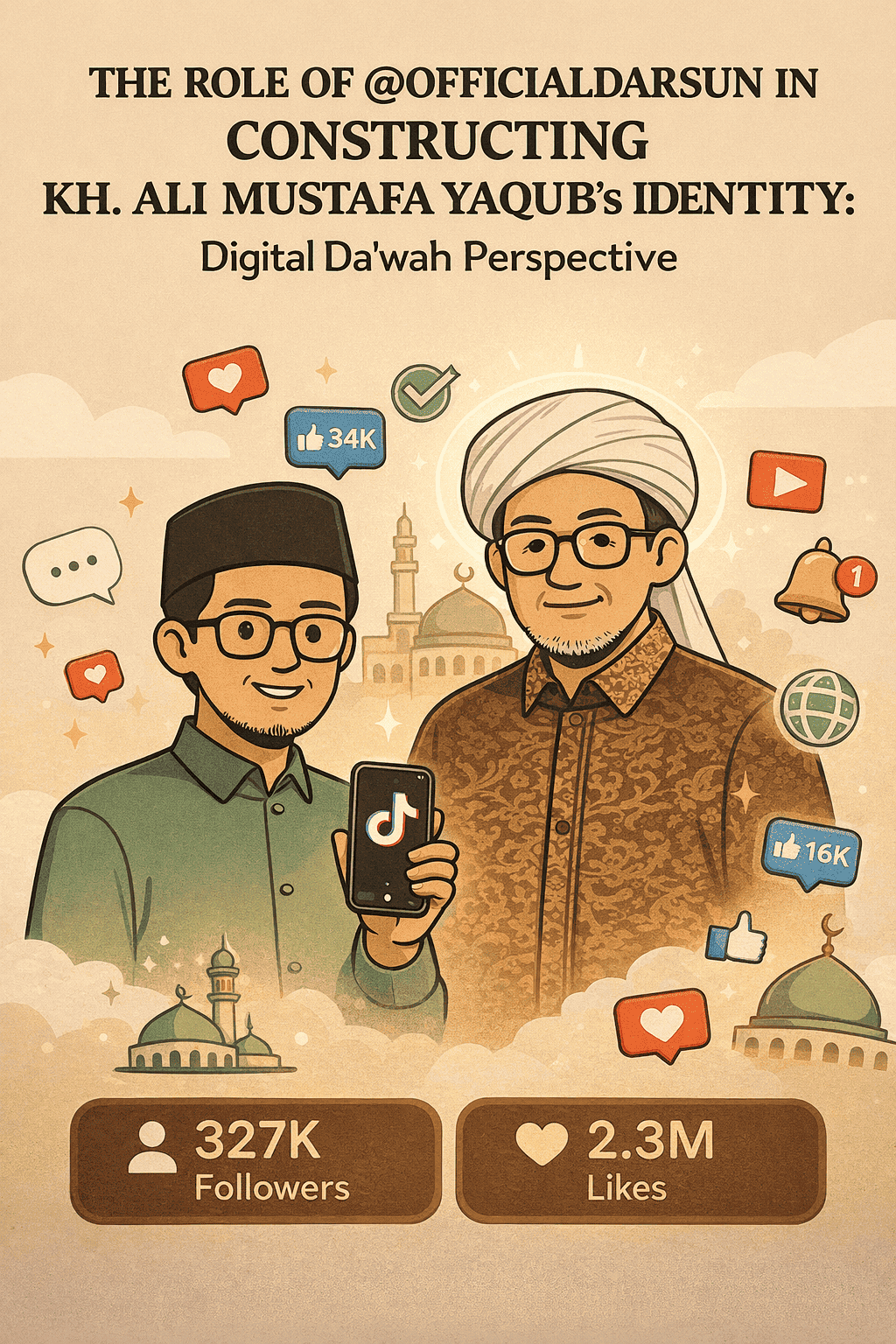
THE ROLE OF @OFFICIALDARSUN IN CONSTRUCTING KH. ALI MUSTAFA YAQUB'S IDENTITY: Digital Da’wah Perspective
Article Sidebar
Main Article Content
Abstract
Downloads
Article Details

This work is licensed under a Creative Commons Attribution 4.0 International License.
Authors who publish with this journal agree to the following terms:
Authors retain copyright and grant the journal right of first publication with the work simultaneously licensed under the Creative Commons Attribution International License (CC BY 4.0) that allows others to share the work with an acknowledgement of the works authorship and initial publication in this journal. Authors are able to enter into separate, additional contractual arrangements for the non-exclusive distribution of the journals published version of the work (e.g., post it to an institutional repository or publish it in a book), with an acknowledgement of its initial publication in this journal. Authors are permitted and encouraged to post their work online (e.g., in institutional repositories or on their website) prior to and during the submission process, as it can lead to productive exchanges, as well as earlier and greater citation of published work (See Open Access Sangkép: Jurnal Kajian Sosial Keagamaan).
References
Aulia, F. (2022). Kurasi pada rubrik foto sebagai praktik produksi makna visual. Jurnal Ilmu Komunikasi, 7(2), 113–122.
Bakti, A. F., & Lecomte, I. (2015). The integration of dakwah in journalism: Peace journalism. Jurnal Komunikasi Islam, 5(1).
Bakti, A. F. (2018). Media and religion: Rodja TV’s involvement in the civil society discourse. Malaysian Journal of Communication.
Bakti, A. F. (2020). The contribution of dakwah to communication studies. Jurnal Komunikasi Islam.
Bakti, A. F. (2020). The role of Islamic media in the globalization era. In Trendsetter komunikasi di era digital. Jurnal Komunikasi Islam.
Berger, P. L., & Luckmann, T. (1991). The social construction of reality: A treatise in the sociology of knowledge. Penguin Books.
Boyd, D. (2014). It’s complicated: The social lives of networked teens. Yale University Press.
Branston, G., & Stafford, R. (2006). The Media Student’s Book (3rd ed.). Routledge.
Bunt, G. R. (2018). Hashtag Islam: How cyber-Islamic environments are transforming religious authority. University of North Carolina Press.
Campbell, H. A. (2010). When religion meets new media. Routledge.
Couldry, N. (2012). Media, society, world: Social theory and digital media practice. Polity Press.
Denzin, N. K. (1978). The research act: A theoretical introduction to sociological methods. McGraw-Hill.
Gauntlett, D. (2008). Media, gender, and identity: An introduction. Routledge.
Ghazālī, A. Ḥ. (n.d.). Iḥyā’ ‘Ulūm Al-Dīn (Vol. 1). Dār Al-Ma‘rifah.
Goffman, E. (1959). The presentation of self in everyday life. Doubleday Anchor Books.
Hall, S. (1997). Representation: Cultural representations and signifying practices. Sage.
Hesmondhalgh, D. (2007). The cultural industries (2nd ed.). Sage Publications.
Hine, C. (2000). Virtual ethnography. Sage Publications.
Jufriyanto. (2024). Respon publik terhadap pesan keagamaan di era digital.
Khairina, U. (2021). Strategi dakwah da’i di Instagram. Jurnal Komunikasi Islam, 6(1).
Livingstone, S. (2010). Digital literacies: Understanding media users in the digital age. Routledge.
Livingstone, S. (2004). The challenge of changing audiences. European Journal of Communication, 19(1).
Marwick, A. E. (2013). Status update: Celebrity, publicity, and branding in the social media age. Yale University Press.
Maulidya, N. I. (2023). Perancangan konten media sosial: Studi produksi konten. Skripsi, Universitas Multimedia Nusantara.
Srikandi, M. B., et al. (2023). Analisis gatekeeping audiens pada media sosial. Jurnal Komunikasi Digital, 3(3), 45–55.
Muslim ibn al-Ḥajjāj. (n.d.). Ṣaḥīḥ Muslim. Dār Iḥyā’ Al-Turāth Al-‘Arabī.
Nawawī, Y. ibn S. (n.d.). Al-Majmū‘ Sharḥ Al-Muhadhdhab (Vol. 1). Dār Al-Fikr.
Ṣalāḥ, I. al-. (n.d.). ‘Ulūm Al-Ḥadīth. Dār Al-Fikr.
Proceedings of the International Conference on Islamic Media. (2011). Publications: Routledge.
Savanna, et al. (2025). Content planning strategy in digital media. Journal of Digital Communication.
Shoemaker, P. J., & Reese, S. D. (1991). Mediating the message. Longman.
Walter, T. (2017). Apa arti kematian sekarang: Berpikir kritis tentang kematian dan berduka. Pers Kebijakan