
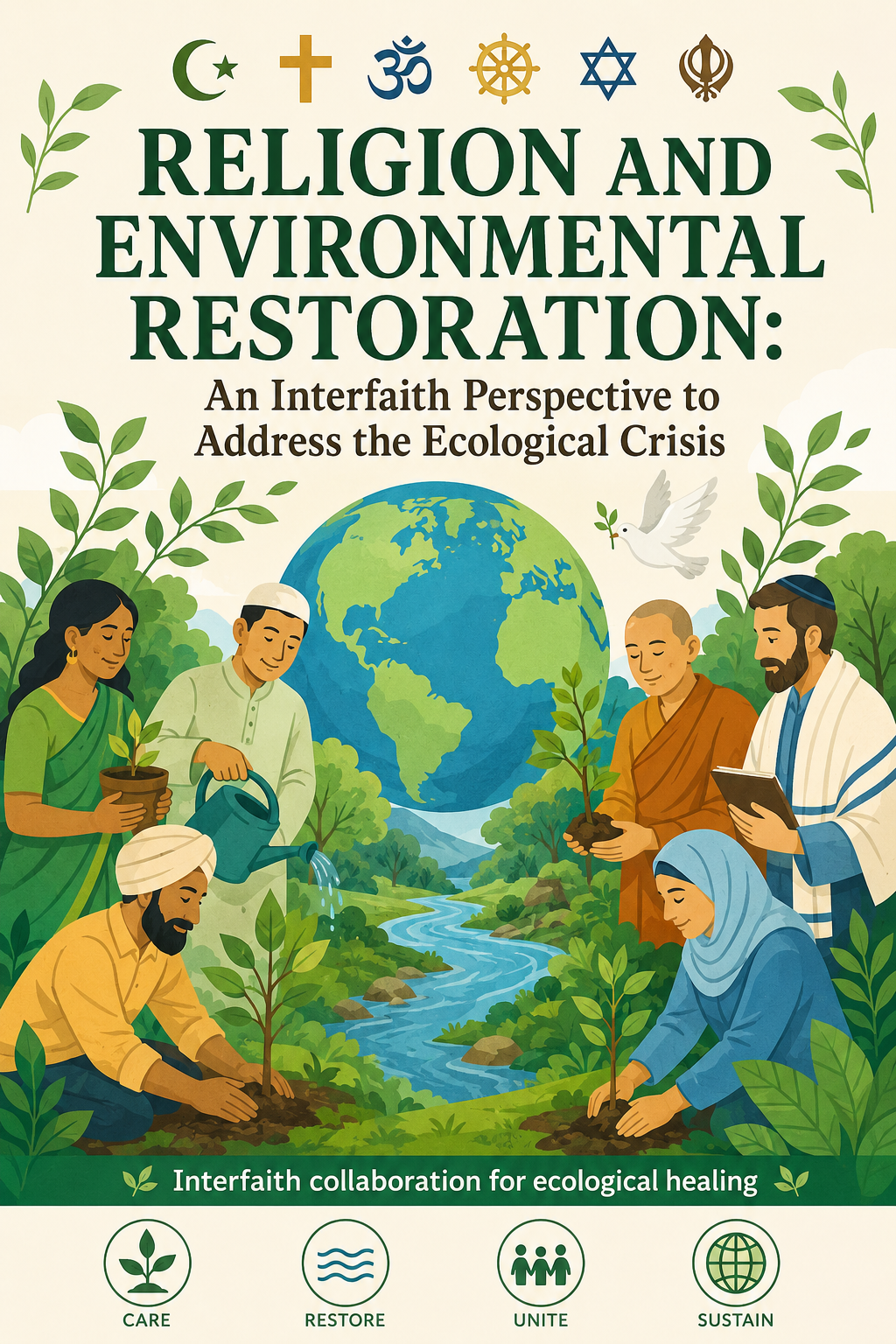
RELIGION AND ENVIRONMENTAL RESTORATION: An Interfaith Perspective to Address the Ecological Crisis
Article Sidebar
Main Article Content
Abstract
The growing global ecological crisis requires a multidisciplinary approach, including contributions from spiritual and religious dimensions. This study is important because it highlights the potential of world religions, through interfaith dialog and cooperation, in shaping environmental ethics and encouraging restorative action against natural destruction. This study aims to explore how an interfaith perspective can strengthen the contribution of religious communities in environmental restoration efforts, what forms interfaith collaboration can take in an ecological context, and how religious values from various traditions can converge to form an inclusive environmental ethic. Using qualitative methods based on literature study and discourse analysis, this research examines theological narratives and environmental praxis in religious documents, as well as interfaith initiatives that have been implemented in various local and global contexts. The main results show that there are universal values such as responsibility for creation, ecological justice, and simplicity of life that serve as common ground between religions in responding to the environmental crisis. In addition, faith-based collaborative practices are proven to strengthen the capacity of communities to manage and restore local ecosystems. The integration of religious perspectives in the environmental restoration movement not only enriches the ecological approach, but also broadens the base of public participation through a deep spiritual foundation.
Downloads
Article Details

This work is licensed under a Creative Commons Attribution 4.0 International License.
Authors who publish with this journal agree to the following terms:
Authors retain copyright and grant the journal right of first publication with the work simultaneously licensed under the Creative Commons Attribution International License (CC BY 4.0) that allows others to share the work with an acknowledgement of the works authorship and initial publication in this journal. Authors are able to enter into separate, additional contractual arrangements for the non-exclusive distribution of the journals published version of the work (e.g., post it to an institutional repository or publish it in a book), with an acknowledgement of its initial publication in this journal. Authors are permitted and encouraged to post their work online (e.g., in institutional repositories or on their website) prior to and during the submission process, as it can lead to productive exchanges, as well as earlier and greater citation of published work (See Open Access Sangkép: Jurnal Kajian Sosial Keagamaan).
References
Al-Kassimi, H. , & T. S. (2024). Interfaith environmentalism: Building spiritual alliances for ecological justice. EarthSpirit Press.
Brennan, A. , & L. Y. S. (2022). Environmental Ethics. Stanford Encyclopedia of Philosophy.
Callicott, J. B. (1989). In Defense of the Land Ethic: Essays in Environmental Philosophy. State University of New York Press, Albany.
Clooney, F. (2010). The new comparative theology: Interreligious insights from the next generation (F. Clooney, Ed.). T&T Clark.
Cornille, C. & C. C. (2010). Interreligious hermeneutics. Cascade Books.
Creswell, J. W. (2013). Qualitative Inquiry and Research Design: Choosing Among Five Approaches (3rd ed.). SAGE Publications.
Denzin, N. K. , & L. Y. S. (2018). The SAGE Handbook of Qualitative Research (5th ed.). SAGE Publications.
Fowler, R. , W. C. , & G. R. (2023). Ecological Theology in the Anthropocene. Cambridge University Press.
Ghazali, R. , U. D. , & N. A. (2023). Peran Agama dalam Pembangunan Berkelanjutan: Perspektif Interfaith Environmentalism. Jurnal Sosial Humaniora, 2(15), 89–102.
Herdiansyah, H., Sukmana, H., & Lestarini, R. (2019). Eco-Pesantren as A Basic Forming of Environmental Moral and Theology. KALAM, 12(2), 303–326. https://doi.org/10.24042/klm.v12i2.2834
Hitzhusen, G. E. , & T. M. E. (2023). Faith, Ecology, and Climate Change: Interreligious Responses. Yale Forum on Religion and Ecology.
IPCC. (2023). Sixth Assessment Report: Climate Change 2023—Synthesis Report. Intergovernmental Panel on Climate Change.
IRI (Interfaith Rainforest Initiative). (2023). Interfaith Action for the Forests: Lessons from Southeast Asia. Https://Www.Interfaithrainforest.Org/Resources.
Jonas, H. (1992). The Burden and Blessing of Mortality. The Hastings Center Report, 22(1), 34. https://doi.org/10.2307/3562722
Kearns, L. & K. C. (2007). Ecospirit: Religions and philosophies for the earth. Fordham University Press.
Khotimah, K., Taembo, M., Hipni, M., & Lutfitasari, W. (2024). Sustainable Character Formation in Eco-Pesantren: a Linguistic and Spiritual Ecology Perspective Under the SDGs Framework. Journal of Lifestyle and SDGs Review, 5(1), e02519. https://doi.org/10.47172/2965-730X.SDGsReview.v5.n01.pe02519
LIPI & Wahid Foundation. (2023). Pesantren Hijau: Lintas Iman dalam Aksi Ekologis.
McKim, R. (2024). Prospects and possibilities for interfaith environmentalism. Religious Studies, 60(1), 147–159. https://doi.org/10.1017/S0034412523000069
MUI. (2023). Fatwa MUI Nomor 4 Tahun 2023 tentang Pelestarian Lingkungan dalam Perspektif Islam.
Nasrullah, F. , & I. M. (2023). ). Religious leaders and ecological literacy: Mobilizing faith-based communities for climate action in Southeast Asia. International Journal of Religion and Ecology, 1(4), 19–35.
Patel, E. & B. P. (2006). Building the interfaith youth movement: Beyond dialogue to action. Rowman & Littlefield Publishers.
Purnawanto, A. T. (2024). Mambangun Kesadaran Lingkungan Untuk Mitigasi Perubahan Iklim: Perspektif Islam. JURNAL PEDAGOGY, 17(1), 1–19. https://doi.org/10.63889/pedagogy.v17i1.207
Rangga Kala Mahaswa, Jagat Patria, Anicetus Wihardjaka, Elisabeth Srihayu Harsanti, Yayan Apriyana, Woro Estiningtyas, Ai Dariah, Elsa Rakhmi Dewi, Al Mukhollis Siagian, Nani Heryani, Popi Rejekiningrum, Budi Kartiwa, Hendri Sosiawan, Tri Astuti Sugiyatmi, Yeni Widiawati, Mohammad Ikhsan Shiddieqy, Eni Siti Rohaeni, Yenny Nur Anggraeny, Firsoni, … Idi Subandy Ibrahim. (2023). Teknologi dan Kearifan Lokal untuk Adaptasi Perubahan Iklim (Elza Surmaini, Lilik Slamet Supriatin, & Yeli Sarvina, Eds.). Penerbit BRIN. https://doi.org/10.55981/brin.901
Richardson, M. (2025). Becoming a Network of Networks: G20 Interfaith Forum. Journal of Nonprofit Innovation, 5(1).
Romdloni, M. A., & Sukron Djazilan, M. (2019). Kiai dan Lingkungan Hidup; Revitalisasi Krisis Ekologis Berbasis Nilai Keagamaan di Indonesia. Journal of Islamic Civilization, 1(2), 119–129. https://doi.org/10.33086/jic.v1i2.1322
Sovacool, B. K., Hess, D. J., Cantoni, R., Lee, D., Claire Brisbois, M., Jakob Walnum, H., Freng Dale, R., Johnsen Rygg, B., Korsnes, M., Goswami, A., Kedia, S., & Goel, S. (2022). Conflicted transitions: Exploring the actors, tactics, and outcomes of social opposition against energy infrastructure. Global Environmental Change, 73, 102473. https://doi.org/10.1016/j.gloenvcha.2022.102473
Suryawan, I. W. K., Sianipar, I. M. J., & Lee, C.-H. (2024). Reshaping marine debris management post-COVID-19: Integrating adaptive attributes for enhanced community engagement. Ocean & Coastal Management, 253, 107149. https://doi.org/10.1016/j.ocecoaman.2024.107149
Tucker, M. E. , & G. J. (2023b). Ecology and Religion. Island Press.
Tucker, M. E. , & G. J. (2023c). The Emerging Alliance of Religion and Ecology. Harvard Divinity School.
Ullah, I., Zeng, X.-M., Hina, S., Syed, S., Ma, X., Iyakaremye, V., Yin, J., & Singh, V. P. (2023). Recent and projected changes in water scarcity and unprecedented drought events over Southern Pakistan. Frontiers in Earth Science, 11. https://doi.org/10.3389/feart.2023.1113554
UNEP. (2022). Faith for Earth: A Call for Action. United Nations Environment Programme.
Walker, R. , & H. S. (2024). Sacred Earth: Rituals, empathy, and ecological solidarity in interfaith contexts. Journal for the Study of Religion, Nature and Culture, 2(18), 145–162.
Walker, R. G. (1975). Depositional Sedimentary Environments . H.-E. Reineck , I. B. Singh. The Journal of Geology, 83(4), 534–534. https://doi.org/10.1086/628130
White, S. (2023). Inclusive Environmental Ethics: Religion, Culture, and Policy. Oxford University Press.