
ARISAN AS THE REALITY OF MIDDLE-CLASS URBAN MUSLIM WOMEN IN PEKANBARU CITY
Article Sidebar
Main Article Content
Abstract
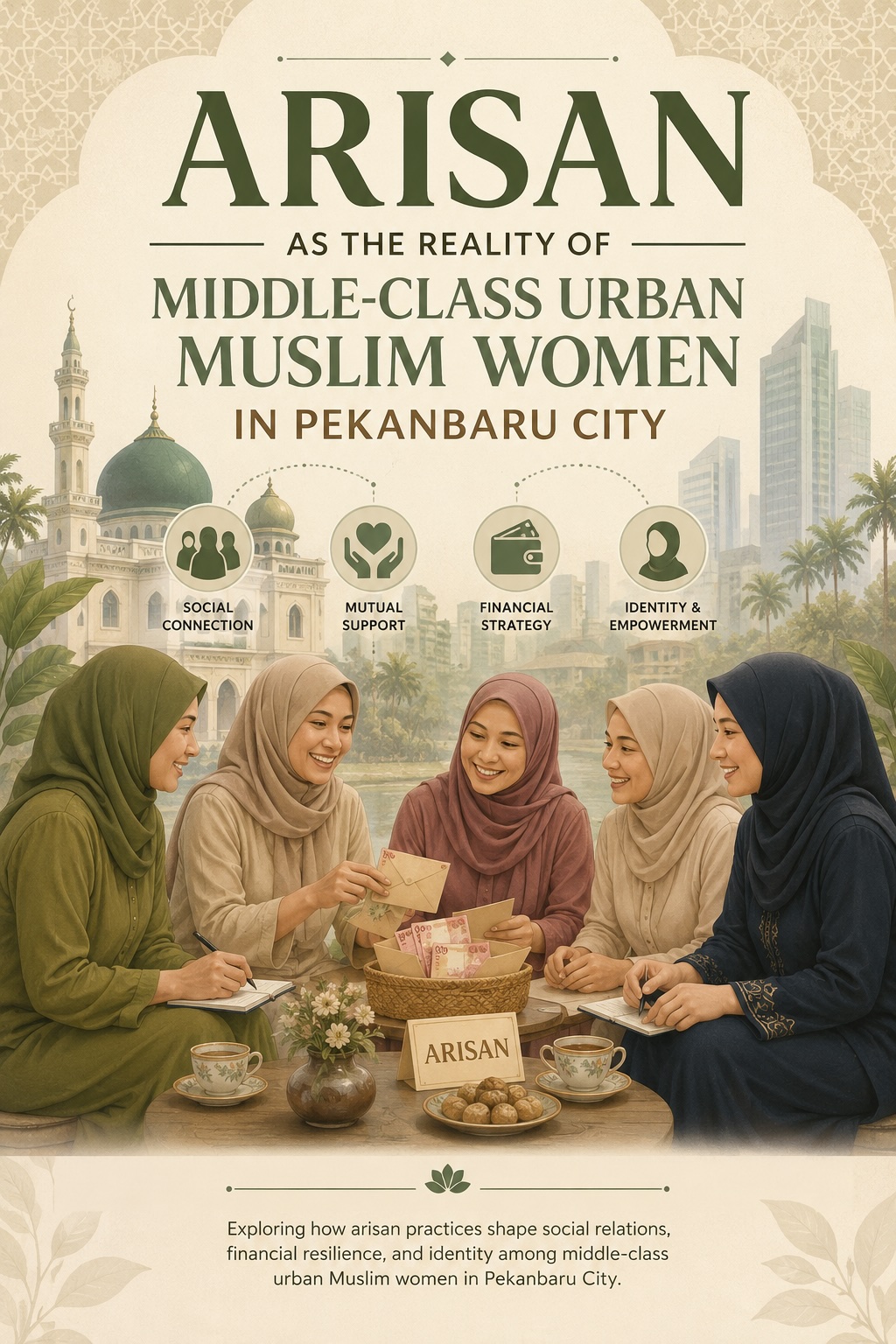
The transformation of arisan practices in urban society, which initially functioned as a rotating savings activity, has developed into a social space rich in symbols, lifestyle expressions, and status representation. This transformation is evident in one arisan group in Pekanbaru City, namely the Kak Jil Arisan Group. This study aims to identify the social representations embedded in the activities of the Kak Jil Arisan Group and to explain the meaning of sign values displayed through symbolic consumption practices using Jean Baudrillard’s Theory of Simulation and Simulacra. A qualitative method with a phenomenological approach was employed to achieve the research objectives through in-depth interviews, observation, and documentation techniques. Primary and secondary data were obtained from seven members of the Kak Jil Arisan Group selected through purposive sampling, along with two supporting informants to enrich the research data. Data were analyzed using the Miles and Huberman model and validated through source and method triangulation. The findings indicate that the Kak Jil Arisan Group represents middle-class urban Muslim women who construct their identity and social existence through symbolic consumption. Dress codes, fashion trends, branded accessories, choice of venues, menu selection, and vehicles used to attend arisan gatherings function as status markers and as forms of nonverbal communication to demonstrate prestige and group cohesion. The emerging sign values reflect members’ efforts to assert social position, financial success, modern lifestyle, solidarity, and conformity. For urban Muslim women, arisan is not merely a financial activity but has become an arena of social performativity, a space for identity simulation, and a medium for gaining recognition and positioning within urban group interaction structures.
Downloads
Article Details

This work is licensed under a Creative Commons Attribution 4.0 International License.
Authors who publish with this journal agree to the following terms:
Authors retain copyright and grant the journal right of first publication with the work simultaneously licensed under the Creative Commons Attribution International License (CC BY 4.0) that allows others to share the work with an acknowledgement of the works authorship and initial publication in this journal. Authors are able to enter into separate, additional contractual arrangements for the non-exclusive distribution of the journals published version of the work (e.g., post it to an institutional repository or publish it in a book), with an acknowledgement of its initial publication in this journal. Authors are permitted and encouraged to post their work online (e.g., in institutional repositories or on their website) prior to and during the submission process, as it can lead to productive exchanges, as well as earlier and greater citation of published work (See Open Access Sangkép: Jurnal Kajian Sosial Keagamaan).