
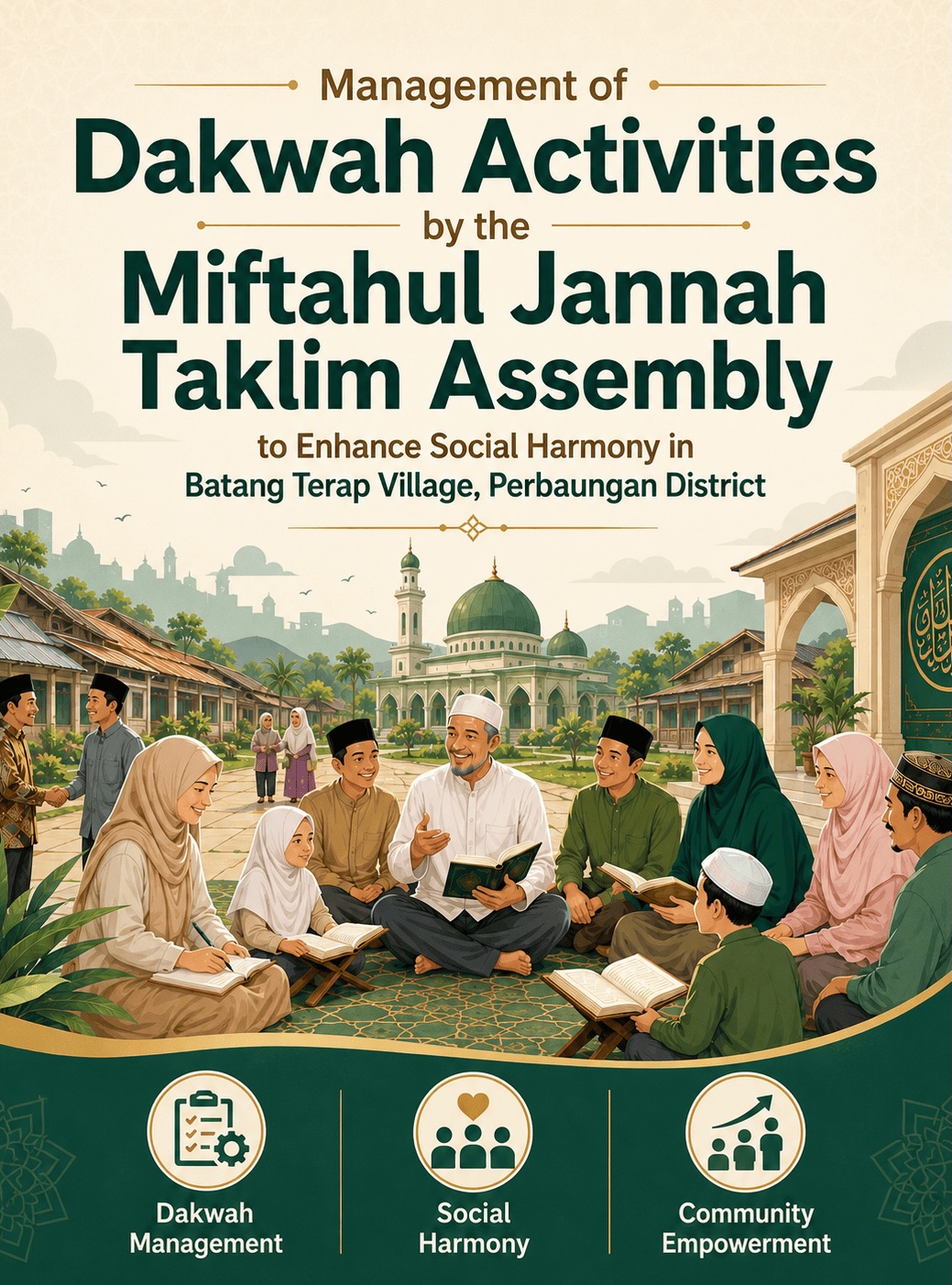
MANAGEMENT OF DAKWAH ACTIVITIES BY THE MIFTAHUL JANNAH TAKLIM ASSEMBLY TO ENHANCE SOCIAL HARMONY IN BATANG TERAP VILLAGE, PERBAUNGAN DISTRICT
Article Sidebar
Main Article Content
Abstract
The significance of effective da'wah management in supporting the development of harmonious family life within communities underpins this research. The Miftahul Jannah Taklim Assembly, a non-formal da'wah institution, conducts religious development activities that emphasize both enhancing religious understanding and strengthening family life among its congregation. This study investigates the da'wah management practices of the Miftahul Jannah Taklim Assembly in promoting family harmony in Batang Terap Village, Perbaungan District. A qualitative research method with a descriptive approach was employed. Data collection involved observation, interviews, and documentation, with research informants comprising the head of the taklim assembly and congregation members. Findings indicate that da'wah management at the Miftahul Jannah Taklim Assembly is operationalized through the functions of planning, organizing, implementing, and evaluating. Planning involves preparing schedules for religious studies and selecting materials relevant to the congregation's needs. Organization is achieved through the allocation of responsibilities among administrators. Da'wah activities are carried out via regular religious studies and social programs. Evaluation is conducted by monitoring attendance, participation, and observable changes in congregational attitudes. The implementation of these da'wah management practices has contributed positively to family harmony within the congregation, particularly by enhancing communication, patience, and relationships among family members.
Downloads
Article Details

This work is licensed under a Creative Commons Attribution 4.0 International License.
Authors who publish with this journal agree to the following terms:
Authors retain copyright and grant the journal right of first publication with the work simultaneously licensed under the Creative Commons Attribution International License (CC BY 4.0) that allows others to share the work with an acknowledgement of the works authorship and initial publication in this journal. Authors are able to enter into separate, additional contractual arrangements for the non-exclusive distribution of the journals published version of the work (e.g., post it to an institutional repository or publish it in a book), with an acknowledgement of its initial publication in this journal. Authors are permitted and encouraged to post their work online (e.g., in institutional repositories or on their website) prior to and during the submission process, as it can lead to productive exchanges, as well as earlier and greater citation of published work (See Open Access Sangkép: Jurnal Kajian Sosial Keagamaan).
References
Abdullah, M. (2021). Qualitative research methodology. Aswaja Pressindo.
Aini, N., & Fauzi, A. (2022). The management of da’wah of the taklim council in increasing the religious understanding of the community. Journal of Da'wah Management, 5(1), 25–38.
Arikunto, S. (2021). Research procedure: A practical approach. Rineka Cipta.
Aziz, M. A. (2019). Da’wah science. Kencana.
Azizah, N., & Nurhayati. (2024). The role of the taklim council in fostering family and community life. Journal of Islamic Education and Da’wah, 8(1), 45–57.
Basit, A. (2013). The philosophy of da’wah. Rajawali Press.
Basit, A. (2023). The philosophy of da’wah. Rajawali Press.
Bungin, B. (2020). Qualitative research: Communication, economics, public policy and other social sciences. Kencana.
Creswell, J. W. (2021). Research design: Qualitative, quantitative, and mixed methods approach (Translation). Student Library.
Hafidhuddin, D. (2020). Actual dakwah. Gema Insani.
Herdiansyah, H. (2020). Qualitative research methodology for the social sciences. Salemba Humanika.
Kusnawan, A. (2021). Communication and da’wah management. Simbiosa Rekatama Media.
Kusnawan, A. (2022). Contemporary da’wah management. Simbiosa Rekatama Media.
Miles, M. B., Huberman, A. M., & Saldaña, J. (2020). Qualitative data analysis: A methods sourcebook. Sage Publications.
Moleong, L. J. (2021). Qualitative research methodology. PT Remaja Rosdakarya.
Munir, M., & Elihi, W. (2021). Da’wah management. Kencana.
Nisa, A., & Hidayat, R. (2023). Religious guidance in facing the challenges of modern family life. Journal of Da’wah and Islamic Community Development, 7(2), 102–115.
Rahmah, S. (2023). The role of the taklim council in fostering the harmony of Muslim families. Journal of Islamic Guidance and Counseling, 6(2), 88–101.
Rizki, M., & Nurhayati. (2024). Implementation of da’wah management in community da’wah institutions. Journal of Da’wah Management and Islamic Communication, 9(1), 12–28.
Shaleh, R. (2021). Islamic da’wah management. Bulan Bintang.
Sugiyono. (2022). Qualitative research methods. Alfabeta.
Suhartini. (2022). Majelis taklim as a means of Islamic education for the community. Journal of Islamic and Social Education, 4(2), 67–79.
Sukayat, T. (2022). Da’wah management. Simbiosa Rekatama Media.
Other Source
Napitu, S. (2026). [Interview with the Chairman of the Miftahul Jannah Taklim Council, Batang Terap Village, Perbaungan District]. Unpublished raw data.
Siregar, F. (2026). [Interview with a member of the Miftahul Jannah Taklim Council, Batang Terap Village, Perbaungan District]. Unpublished raw data.
Suryani, E. (2026). [Interview with a member of the Miftahul Jannah Taklim Council, Batang Terap Village, Perbaungan District]. Unpublished raw data.