
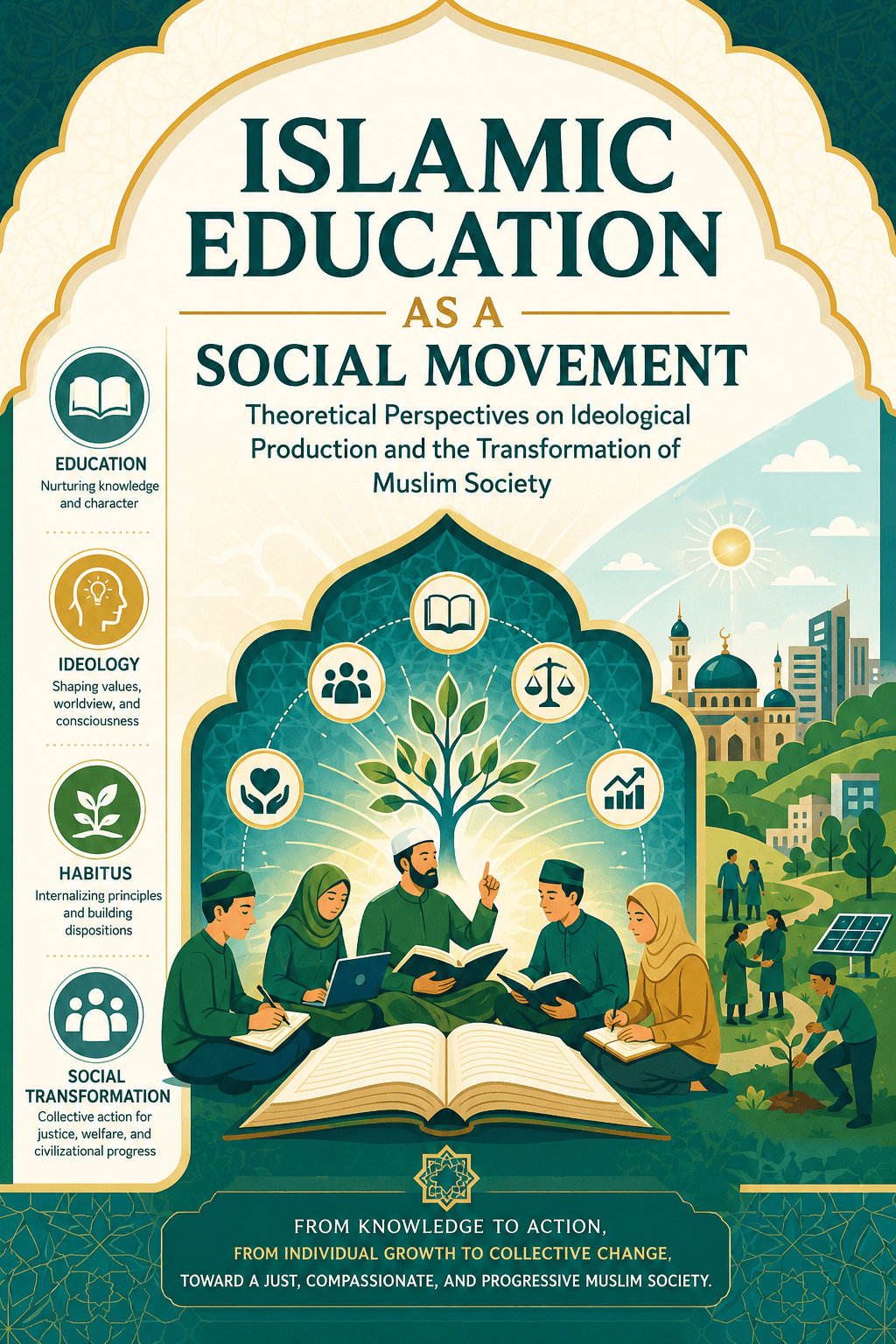
ISLAMIC EDUCATION AS A SOCIAL MOVEMENT: Theoretical Analysis of Ideological Production and the Transformation of Muslim Society
Article Sidebar
Main Article Content
Abstract
This article examines Islamic education as a social movement that contributes to ideological production, the formation of habitus, and the transformation of Muslim society in Indonesia. Employing a qualitative methodology, the study utilizes library research to review theoretical works and academic literature on social movements, hegemony, habitus, and the sociology of Islamic education. The findings indicate that Islamic education functions not only as an institution for transmitting religious knowledge but also as a cultural arena where religious values are produced, negotiated, legitimised, and internalised through curriculum, teacher and kiai authority, and everyday social practices. These processes shape a religious habitus that influences religious understanding, social identity, interactional patterns, and collective moral orientation. The theoretical synthesis presented in this article posits that Islamic education is a dynamic socio-cultural movement capable of both reproducing and transforming social structures. The article advocates for strengthening reflective, inclusive, and contextual Islamic education to address global change, the digitalisation of religious authority, and the plural realities of contemporary Muslim society. The implications of this study inform the development of the sociology of Islamic education and the formulation of moderate institutional policy.
Downloads
Article Details

This work is licensed under a Creative Commons Attribution 4.0 International License.
Authors who publish with this journal agree to the following terms:
Authors retain copyright and grant the journal right of first publication with the work simultaneously licensed under the Creative Commons Attribution International License (CC BY 4.0) that allows others to share the work with an acknowledgement of the works authorship and initial publication in this journal. Authors are able to enter into separate, additional contractual arrangements for the non-exclusive distribution of the journals published version of the work (e.g., post it to an institutional repository or publish it in a book), with an acknowledgement of its initial publication in this journal. Authors are permitted and encouraged to post their work online (e.g., in institutional repositories or on their website) prior to and during the submission process, as it can lead to productive exchanges, as well as earlier and greater citation of published work (See Open Access Sangkép: Jurnal Kajian Sosial Keagamaan).
References
Azra, A., & Thaha, I. (2012). Pendidikan Islam: Tradisi dan modernisasi di tengah tantangan milenium III (Cet. 1). Kencana bekerja sama dengan UIN Jakarta Press.
Bourdieu, P. (1977). Outline of a theory of practice. Cambridge University Press.
Bourdieu, P. (2008). The logic of practice (Reprinted). Stanford University Press.
Busthomi, Y., & Wahyuni, S. (2024). Pengembangan komponen tujuan kurikulum Pendidikan Agama Islam (PAI) multikultural di pondok pesantren. Dirasah: Jurnal Studi Ilmu dan Manajemen Pendidikan Islam, 7(2), 742–751. https://doi.org/10.58401/dirasah.v7i2.1487
Campbell, H. (Ed.). (2013). Religious practice in new media worlds. Routledge.
Dhofier, Z. (1982). Tradisi pesantren: Studi tentang pandangan hidup kyai. LP3ES.
Dhofier, Z. (2011). Tradisi pesantren: Studi pandangan hidup kyai dan visinya mengenai masa depan Indonesia (Cet. 8 rev.). LP3ES.
Eickelman, D. F., & Anderson, J. W. (Eds.). (2003). New media in the Muslim world: The emerging public sphere (2nd ed.). Indiana University Press.
Foucault, M. (1980). Power/knowledge: Selected interviews and other writings, 1972–1977. Pantheon Books.
GoodStats. (2025). 10 provinsi dengan pondok pesantren terbanyak 2025. https://data.goodstats.id/statistic/10-provinsi-dengan-pondok-pesantren-terbanyak-2025-LlZsK
Gramsci, A. (1971). Selections from the prison notebooks. International Publishers.
Habib Zainuri, Rahman, F., Mandagi, D. W., Zainuddin Rela, I., Nurtanto, M., Rusman, M. A., Syafrizal, Hafni Sahir, S., Simarmata, J., & Aini. (2021). Metodologi penelitian pendidikan: Sebuah pengantar. Yayasan Kita Menulis.
Hefner, R. W. (2016). Indonesia, Islam, and the new U.S. administration. The Review of Faith & International Affairs, 14(2), 59–66. https://doi.org/10.1080/15570274.2016.1184444
Hefner, R. W. (Ed.). (2009). Making modern Muslims: The politics of Islamic education in Southeast Asia. University of Hawai‘i Press.
Hefner, R. W. (Ed.). (2011). Shari’a politics: Islamic law and society in the modern world. Indiana University Press.
Hefner, R. W., & Andaya, B. W. (Eds.). (2018). Routledge handbook of contemporary Indonesia. Routledge. https://doi.org/10.4324/9781315628837
Jayadi, S. (2025). Harmony in Diversity: Exploring Religiosity Cohesion Among Muslim, Hindu, and Buddhist Communities in North Lombok, Indonesia. Journal of Islamic Thought and Civilization, 15(1), 261-276.
Katadata. (2025). Statistik sekolah berbasis agama Islam di Indonesia 2024/2025. https://databoks.katadata.co.id/demografi/statistik/67ceacbd97b23/statistik-sekolah-berbasis-agama-islam-di-indonesia-20242025
Kementerian Agama DIY. (2025). Kenapa dibutuhkan Ditjen Pesantren? Ini penjelasan Wamenag. https://diy.kemenag.go.id/news/51045-kenapa-dibutuhkan-ditjen-pesantren-ini-penjelasan-wamenag.html
Khabib Mustofa, Hernawati, S., & Rofingah, M. N. S. (2025). Pengembangan kurikulum pendidikan agama di pesantren, sekolah dan madrasah. Al-I’tibar: Jurnal Pendidikan Islam, 12(1), 72–79. https://doi.org/10.30599/jxhr7g68
Khurniawan, A. W., Sailah, I., Muljono, P., Indriyanto, B., & Maarif, M. S. (2020). An analysis of implementing total quality management in education: Success and challenging factors. International Journal of Learning and Development, 10(2), 44. https://doi.org/10.5296/ijld.v10i2.17270
Lindsey, T., & Pausacker, H. (Eds.). (2016). Religion, law and intolerance in Indonesia. Routledge. https://doi.org/10.4324/9781315657356
Madjid, N. (1992). Islam, kemodernan dan keindonesiaan (Edisi 4). Mizan.
Marwiji, M. H., Wahyudin, W., Setiono, J., Qomaruzzaman, B., & Zaqiah, Q. Y. (2024). Integrasi kurikulum pondok pesantren dan madrasah aliyah pada mata pelajaran rumpun Pendidikan Agama Islam di Alwasilah Lilhasanah Islamic Boarding School. JIIP: Jurnal Ilmiah Ilmu Pendidikan, 7(3), 2528–2535. https://doi.org/10.54371/jiip.v7i3.4100
Poorghorban, Y. (2023). On Michel Foucault: Power/knowledge, discourse, and subjectivity. OKARA: Jurnal Bahasa dan Sastra, 17(2), 318–328. https://doi.org/10.19105/ojbs.v17i2.9749
Prentki, T., & Abraham, N. (Eds.). (2021). The applied theatre reader (2nd ed.). Routledge.
Roy, O. (2014). Holy ignorance: When religion and culture part ways. Oxford University Press.
Saeed, A. (2014). Reading the Qur’an in the twenty-first century: A contextualist approach. Routledge.
Sagala, R. (2019). Peran Majelis Taklim Al-Hidayah dalam pendidikan Islam dan gerakan sosial keagamaan di Propinsi Lampung. AL-MURABBI: Jurnal Studi Kependidikan dan Keislaman, 6(1), 27–36. https://doi.org/10.53627/jam.v6i1.3632
Seidman, S., & Alexander, J. C. (Eds.). (2020). The new social theory reader (2nd ed.). Routledge. https://doi.org/10.4324/9781003060963
Suryati, A. (2023). Pendidikan Islam dan perubahan sosial. Jurnal Pendidikan Tambusai, 7(3). https://doi.org/10.31004/jptam.v7i3.11402
Sutrisnawati, M. S., & Pangestuti, R. (2024). Pesantren sebagai media moderasi beragama di Indonesia. Jurnal Penelitian Agama, 25(1), 89–103. https://doi.org/10.24090/jpa.v25i1.2024.pp89-103
Tabi’in, A., Hasibuan, L., & Us, K. A. (2022). Pendidikan Islam, perubahan sosial, dan pembangunan di Indonesia. Asatiza: Jurnal Pendidikan, 3(1), 48–59. https://doi.org/10.46963/asatiza.v3i1.469
Tiya, D. (2025). Manajemen kurikulum pembelajaran Islam di pesantren menghadapi era modern. AKSI: Jurnal Manajemen Pendidikan Islam, 3(3), 161–174. https://doi.org/10.37348/aksi.v3i3.624
Van Bruinessen, M. (Ed.). (2013). Contemporary developments in Indonesian Islam: Explaining the conservative turn. ISEAS Publishing.