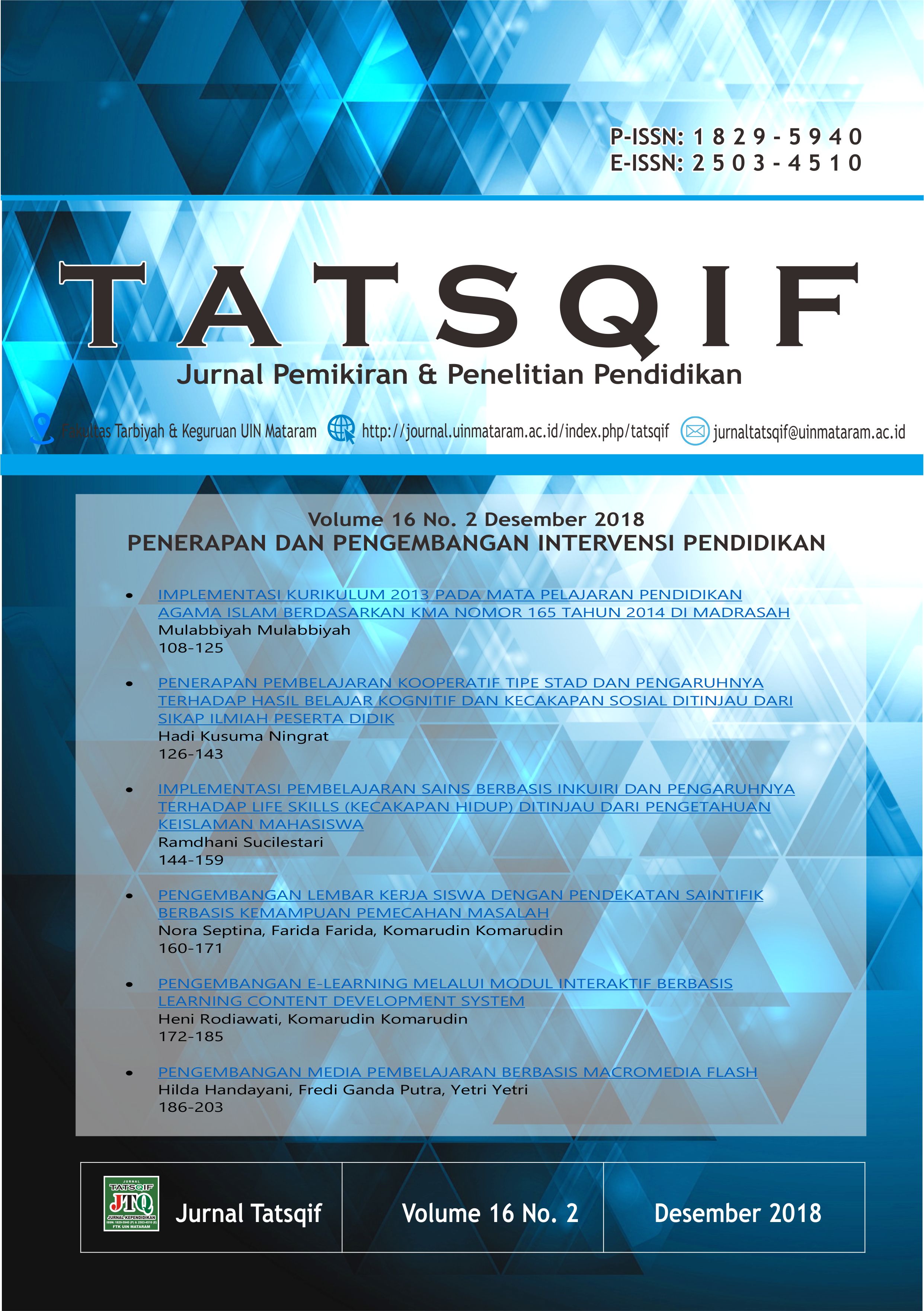
IMPLEMENTASI KURIKULUM 2013 PADA MATA PELAJARAN PENDIDIKAN AGAMA ISLAM BERDASARKAN KMA NOMOR 165 TAHUN 2014 DI MADRASAH
DOI:
https://doi.org/10.20414/jtq.v16i2.470Keywords:
Implementasi Kurikulum 2013; Mata Pelajaran Pendidikan Agama Islam; Madrasah Ibtidaiyah;Abstract
The current research intends to clarify (1) the implementation of the two-thousand-and-thirteen curriculum for Islamic Education at Primary Islamic Schools of Mataram, including three aspects of learning, such as planning, teaching, and assessment, and (2) the obstacles in implementing the curriculum. It is a qualitative research utilizing teacher interviews and document studies as the source of the data. The findings indicate that the subjects had implemented the two-thousand-and-thirteen curriculum at the three aspects of learning, such as teaching plan, teaching implementation dan teaching assessment. However, there are some obstacles faced by the subject, such as lack of understanding abbot the two-thousand-and-thirteen curriculum, too many teacher-administration tasks, teaching time-limit, abnormal of student number, difficulties in implementing scientific approach, lack of facilities to support the learning, abnormal number of assessment instruments to be filled, and difficulties in completing online student report.
Downloads
References
Abdullah. (2016). Implementasi Penilaian Autentik Kurikulum 2013 Pada Pembelajaran Pendidikan Agama Islam di Madrasah Tsanawiyah Negeri 2 Palangka Raya, FITRAH Jurnal Kajian Ilmu-ilmu Keislaman, 2 (2 ), hlm. 59 – 82.
Fullan, M.G.. (2007). School Development; The New Meaning of Educational Change. New Yorks: Teacher College Press.
Hidayat, Titiek Rohanah. (2015). Implementasi Pengembangan Kurikulum 2013 dalam Pembelajaran Pendidikan Agama Islam dan Budi Pekerti di SMA Negeri 4 Jember. FENOMENA, 14 (1 April), hlm.1-19.
Kemenag. 2014. Keputusan Menteri Agama Nomor 165 Tahun 2014 tentang Pedoman Kurikulum Madrasah 2013 Mata Pelajaran PAI dan Bahasa Arab. Jakarta; Kementerian Agama RI.
----------. 2014. Keputusan Menteri Agama Nomor 207 Tahun 2014 tentang Kurikulum Madrasah. Jakarta; Kementerian Agama RI.
--------. 2014. Lampiran KMA. No. 165 tahun 2016 tentang pedoman kurikulum madrasah 2013 mata pelajaran PAI dan Bahasa Arab. Jakarta; Kementerian Agama RI.
Kemendikbud. 2013. Lampiran Permendikbud. Nomor 68 tahun 2013 tentang kerangka dasar dan struktur kurikulum Sekolah Dasar/Madrasah Ibtidaiyah. Jakarta: Kementerian Pendidikan dan Kebudayaan.
------------. 2016. Lampiran Permendikbud nomor 22 tahun 2016 tentang Standar Proses Pendidikan Dasar dan Menengah. Jakarta: Kementerian Pendidikan dan Kebudayaan.
Krissandi, Apri Damai Sagita dan Rusmawan. (2015). Kendala Guru Sekolah Dasar dalam Implemenasi Kurikulum 2013, Cakrawala Pendidikan; Jurnal Ilmiah Pendidikan, 3, hlm . DOI: http://dx.doi.org/10.21831/cp.v3i3.7409
Kusnandar. (2007) Guru Profesional; Implementasi KTSP dan Persiapan Menghadapi Sertifikasi Guru. Jakarta: PT. Raja Grafindo Persada.
Majid, Abdul. (2014). Implementasi Kurikulum 2013 Kajian Teorities & Praktis. Bandung: Intersn Media..
Mulyani Mudis Taruna. 2015. Kontribusi Madrasah dalam Penguatan Kurikulum 2013 (Studi Kesiapan Madrasah daam Pelaksanaan Kurikulum 2013 di Jawa Tengah). Analisa Journal of Social Science and Religion. 22 (01 Juni), hlm149 – 160.
Mulyasa. 2009. Implementasi Kurikulum Tingkat Satuan Pendidikan; Kemandirian Guru dan Kepala Madrasah, Jakarta: Bumi Aksara.
Ni’matus Sholihah, Problematika Pendidikan di Madrasah Ibtidaiyah, Sebab-sebab dan Solusinya, Religi: Jurnal Studi Islam, Vol. 6 No. 1 April 2015, h. 82-104.
Peraturan Menteri Pendidikan dan Kebudayaan Nomor 81A tahun 2013 tentang Implementasi Kurikulum.
Peraturan Menteri Pendidikan dan Kebudayaan Nomor 160 Tahun 2014 tentang Pemberlakuan Kurikulum 2006 dan Kurikulum 2013.
Sanjaya, Wina. (2008), Kurikulum dan Pembelajaran, Jakarta: Kencana Prenada Media Group.
Sri Budiani, dkk. 2017. Evaluasi Implementasi Kurikulum 2013 di Sekolah Pelaksana Mandiri. IJCET 6 Vol 1 2017, Htttp://journal.unnes.ac.id/sju/index.php/ujet. hlm. 45 – 57.
Downloads
Published
Issue
Section
License
Tatsqif Journal is an open access journal under the Creative Commons Attribution-ShareAlike 4.0 International License. Authors and readers may copy and redistribute the material in any medium or format, as well as remix, alter, and build upon the material for any purpose, even commercially, but they must give appropriate credit (citing the article or content), provide a link to the license, and indicate if changes were made. If you remix, alter, or build upon the material, you must distribute your contribution under the same license as the original.
Copyright Transfer Agreement
Authors submitting manuscripts with the understanding that if accepted for publication, the copyright of the article will be assigned to Jurnal Tatsqif Faculty of Tarbiyah and Keguruan Universitas Islam Negeri Mataram as the publisher of the journal. Copyright includes the exclusive right to reproduce and transmit the article in all forms and media, as well as translations. The Editor and Board of Editors of Jurnal Tatsqif, Faculty of Tarbiyah and Keguruan, Islamic State University of Mataram make every effort to ensure that no false or misleading data or opinions are published in the journal. In any way, the content of articles published in Tatsqif Journal is the sole and exclusive responsibility of the respective authors.