Online Submission Editorial Team Reviewer List Focus and Scope Article Processing Charges Peer Review Process Screening Plagiarism Open Access Policy Journal License Publication Ethics Reviewer Acknowledgement Visitor Statistics Indexing Editorial Address Author Guidelines

About the Journal
Jurnal Tatsqif (E-ISSN: 2503-4510 P-ISSN: 1829-5940) is a nationally accredited peer-reviewed journal in the field of educational thought and research. Tatsqif Journal is published twice a year (June and December) by Fakultas Tarbiyah dan Keguruan Universitas Islam Negeri Mataram and is available in print and online. This journal encompasses research articles, original research report, reviews in education in any fields including: 1) Research on experimentation of learning methods, strategies or models; 2) Development research on learning activities, materials and media; 3) Classroom action research; 4) Education evaluation and assessment; 5) Study of the educational thoughts, policy, management and leadership
Jurnal Tatsqif is indexed in DOAJ, CrossRef, Sinta, Google Scholar, Garuda, Moraref, ISJD LIPI,WIKIDATA, OpenAlex, Crossref and other indexing institutions.
Current Issue
Vol. 24 No. 1 (2026)
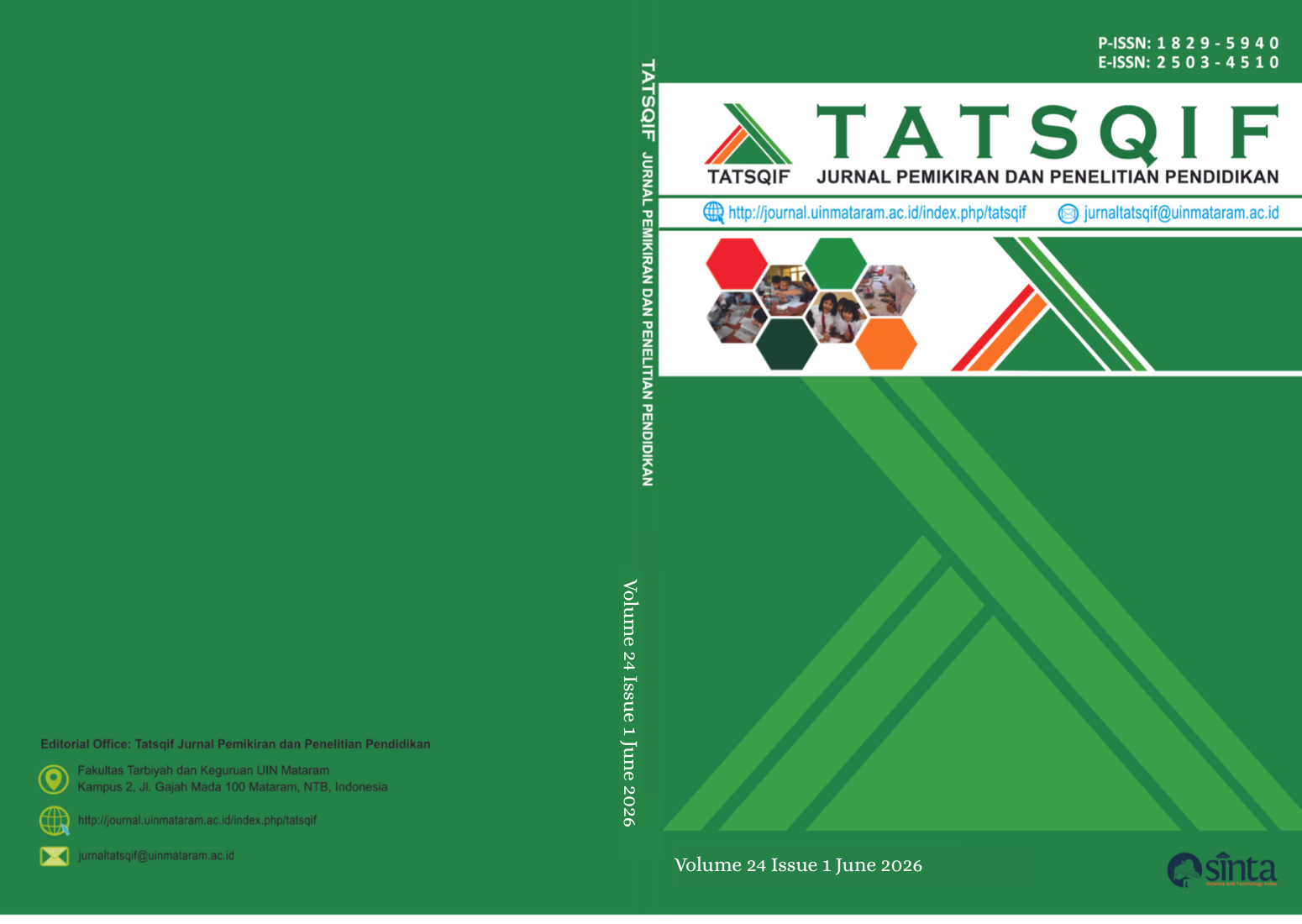
The latest issue of Tatsqif: Journal on Educational Thought and Research, Volume 24 No. 1, 2026, invites readers to explore timely questions at the heart of contemporary education. The issue brings together studies on self-recorded video for EFL speaking, Genially-based interactive media for IPAS learning, audiovisual media in elementary science, manipulative teaching aids in primary mathematics, AI-supported learning in Islamic higher education, and the campus-to-workshop transition of pre-service vocational teachers. Rather than presenting education as an abstract policy discourse, these articles show how teachers and learners negotiate real classroom demands: motivation, reflection, conceptual understanding, technological use, pedagogical guidance, and professional readiness. For scholars, educators, and practitioners, this issue offers grounded evidence and practical insight into how educational innovation becomes meaningful when it is mediated carefully, adapted contextually, and connected to learners’ everyday experiences. It is a relevant issue for anyone interested in responsive and future-oriented education.
Published:
2026-06-29